
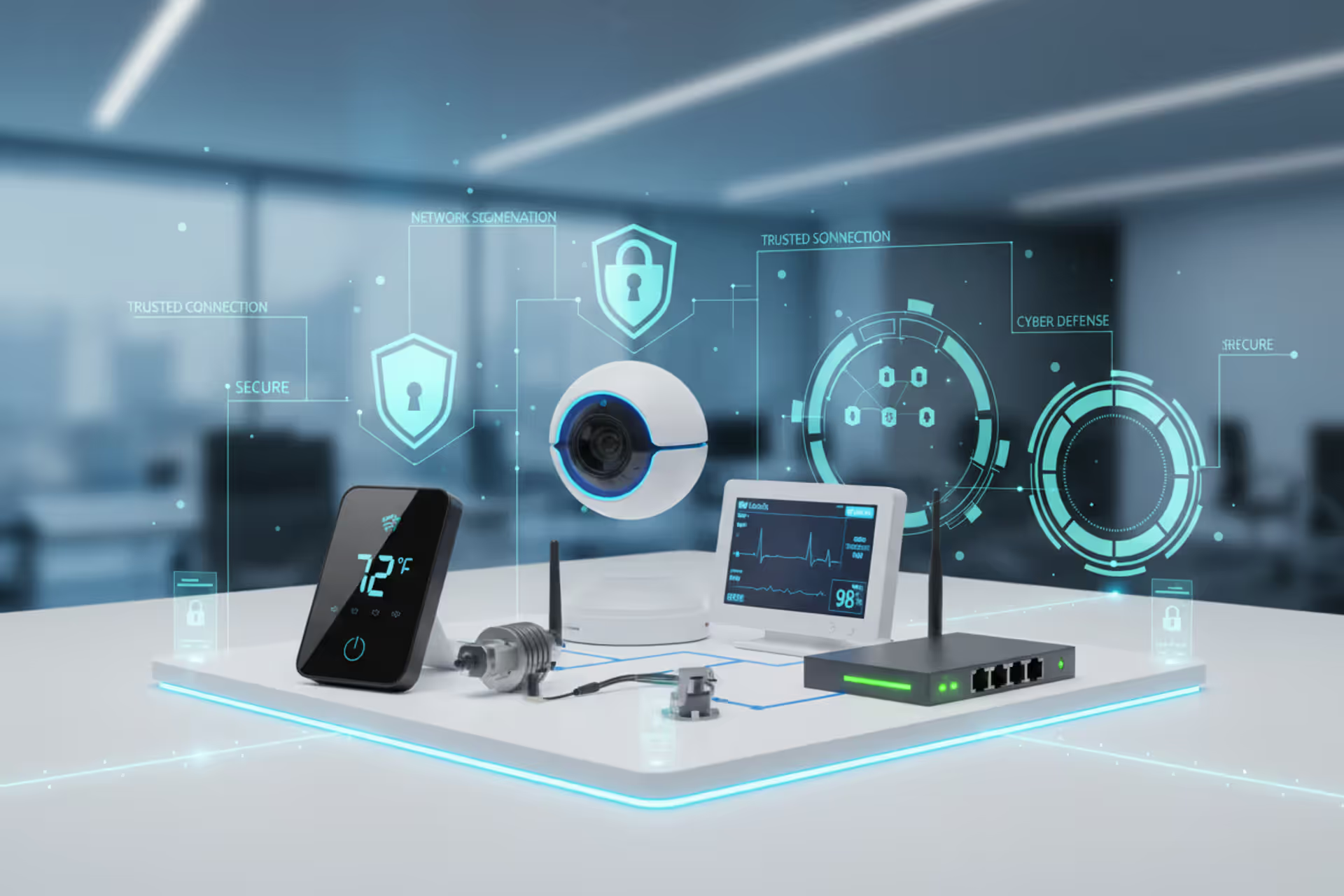
IoT devices protected by cybersecurity layers in a connected network
What Is IoT Endpoint Security?

Content
Content
Here's a startling fact: we're now sharing the planet with roughly 15 billion internet-connected devices—and that number keeps climbing. Your smart thermostat, the security camera outside your office, industrial sensors monitoring assembly lines—each one creates a doorway that hackers can potentially exploit. IoT endpoint security focuses specifically on locking down these individual devices against attacks, unauthorized users, and system takeovers from the moment they're deployed until they're retired.
The challenge? Most connected devices aren't like your laptop or smartphone. Many run on processors no more powerful than a 1990s calculator, have memory measured in kilobytes rather than gigabytes, and lack screens or keyboards for interaction. You can't just install traditional antivirus software and call it a day. Protecting these constrained devices requires fundamentally different strategies that deliver strong security without overwhelming their limited capabilities.
Understanding IoT Endpoints and Their Vulnerabilities
When security professionals talk about IoT endpoints, they mean any physical device that gathers information, processes it, or takes action based on data it receives. Walk through a modern hospital and you'll encounter patient monitors, insulin pumps, and automated medication dispensers. Visit a factory floor and you'll see programmable logic controllers, robotic arms, and environmental sensors. Cities deploy traffic signals, air quality monitors, and surveillance systems across thousands of locations.
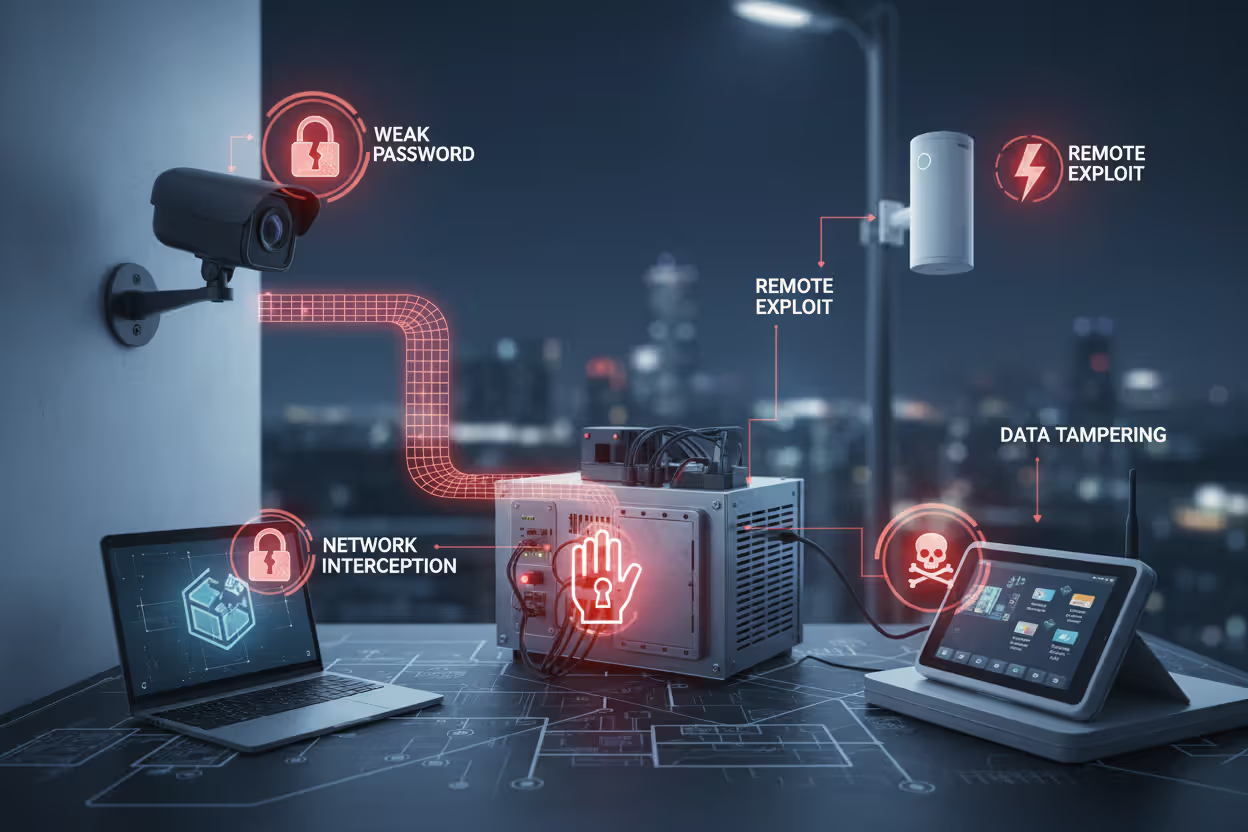
Why do attackers fixate on these devices? The reasons are uncomfortably practical. Research from Verizon's 2025 data breach report revealed that 61% of compromised IoT devices were still running their factory-default passwords—combinations like "admin/admin" that anyone can find with a quick internet search. Device manufacturers, racing to get products to market, frequently skip security hardening that would delay launches. And the sheer number of deployed devices works in attackers' favor; automated scanning tools can probe tens of thousands of devices hourly, looking for easy targets.
Author: Daniel Prescott;
Source: williamalmonte.net
The attack methods exploit predictable weaknesses. Credential stuffing runs through lists of known default usernames and passwords until something works. Firmware exploits target unpatched security holes in device operating systems—especially dangerous since many IoT devices can't update themselves automatically. Man-in-the-middle interception grabs unencrypted data flowing between devices and cloud servers. Physical tampering becomes realistic when devices sit in accessible public spaces or remote locations without guards.
What happens after a device gets compromised? That's where things get worse. A single infected camera doesn't just leak video footage. It becomes a foothold for moving deeper into your network, a soldier in a bot army launching distributed attacks, or a hidden backdoor for stealing sensitive information. The 2024 Mirai variant attacks proved this dramatically—compromised smart cameras generated enough coordinated traffic to knock out major internet infrastructure serving millions of people.
Core Components of IoT Endpoint Security
Building effective IoT endpoint security means layering multiple defenses across different system levels. Relying on any single protection mechanism leaves dangerous gaps.
Authentication verifies that only approved devices and users can access your systems. Modern approaches use digital certificates instead of passwords, with each device receiving a unique cryptographic identity during manufacturing or initial setup. Multi-factor authentication adds extra verification steps, though you'll need creative implementations for devices without screens—hardware security tokens or time-based codes verified through backend management systems.
Encryption scrambles data so intercepted information stays useless to attackers. This applies both to data stored on devices and to communications traveling across networks. AES-256 has become the go-to standard for stored data, while TLS 1.3 protects network traffic. The tricky part? Implementing encryption on a temperature sensor with an 8-bit microcontroller that can barely handle basic math. Lightweight protocols like ChaCha20 deliver solid security while respecting hardware limitations.
Device management gives you centralized visibility and control across potentially thousands of scattered endpoints. Management platforms track what devices you have, monitor their health, push configuration changes, and enforce security rules. Zero-touch provisioning handles secure device setup at scale without manual intervention, while remote attestation checks device integrity before granting network access.
Monitoring catches suspicious behavior that might signal compromise. The system builds behavioral baselines showing normal patterns for each device type—your smart thermostat should communicate with cloud services periodically but shouldn't suddenly start scanning the network for other devices. Deviations from these patterns trigger alerts for your security team to investigate.
| Security Layer | Key Features | Strengths | Limitations |
| Device-Level | Hardware security chips, verified boot processes, encrypted storage, local credential verification | Works independently of network connectivity; stops physical tampering; prevents unauthorized firmware installation | Can't see network-based attacks; needs capable hardware; difficult remote recovery if compromised |
| Network-Level | Firewall rules, isolated network segments, intrusion detection systems, traffic inspection, encrypted tunnels | Watches all device communications; stops malicious traffic patterns; contains compromised devices; centralized updates | Blind to attacks starting on devices; introduces connection delays; requires infrastructure spending |
| Cloud-Level | Centralized rule enforcement, threat intelligence feeds, behavioral pattern analysis, automated incident response | Handles thousands of devices; uses machine learning for threat detection; single management interface; quick policy changes | Needs internet connectivity; raises data privacy questions; may respond slowly to rapid attacks |
How IoT Endpoint Security Protects Connected Devices
IoT endpoint security runs as a continuous cycle starting before devices even reach your facility and continuing until they're decommissioned. Multiple security checkpoints activate at critical moments.
Device onboarding establishes security foundations before devices become operational. During manufacturing, devices get unique cryptographic identities embedded in tamper-resistant hardware. When first connected to your network, each device presents this identity for verification against an authorized registry. Your network confirms the identity, checks that firmware versions match approved releases, and assigns the device to an appropriate security zone based on its function and risk level.
Take a hospital deploying 50 new patient monitors. Each monitor leaves the factory with a manufacturer certificate. After installation and power-up, monitors contact the hospital's device management platform through a dedicated setup network. The platform verifies each certificate, confirms firmware matches approved versions, applies hospital-specific security policies, then moves monitors to the medical device network segment—completely isolated from general IT systems and the internet.
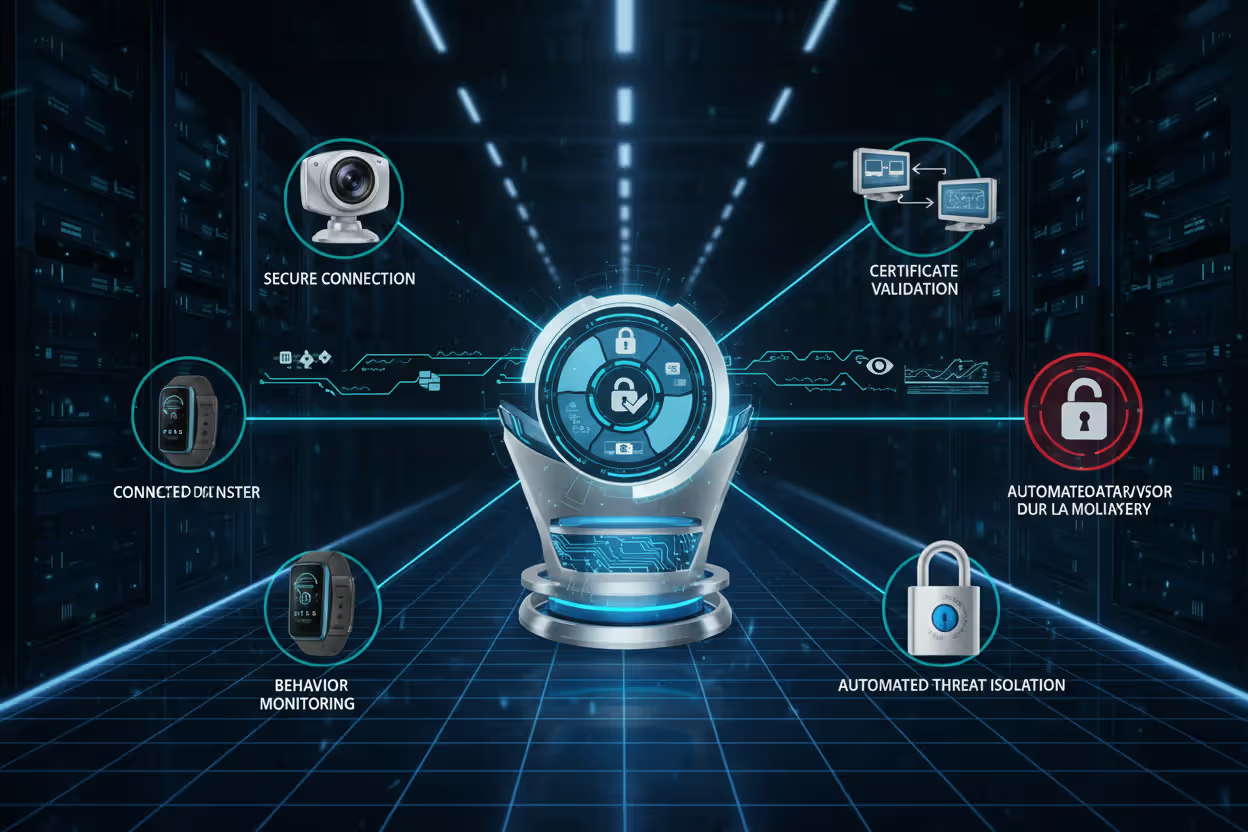
Runtime protection maintains security during daily operations. Verified boot processes check firmware integrity every time devices power on, blocking execution of tampered code. Application whitelisting ensures only approved software runs. Network traffic filtering blocks communications to unauthorized destinations—a smart door lock should only talk to your building management system, not random internet addresses.
Author: Daniel Prescott;
Source: williamalmonte.net
Threat detection spots potential breaches through constant monitoring. Behavioral analytics compare current device activity against established baselines. A temperature sensor suddenly generating ten times normal traffic volume raises immediate red flags. Signature-based detection identifies known malware patterns, while anomaly detection catches novel attacks that don't match existing threat signatures.
Incident response contains and fixes detected threats. Automated responses immediately quarantine suspicious devices from the network, preventing attacks from spreading. Security teams investigate alerts to separate actual breaches from false alarms. Confirmed incidents trigger remediation workflows: reflashing firmware on infected devices, rotating exposed credentials, updating policies to prevent repeat attacks.
Lifecycle management addresses security throughout device lifespans. Regular firmware updates patch newly discovered vulnerabilities. Certificate rotation replaces cryptographic credentials before expiration. Decommissioning procedures securely erase data and revoke credentials when devices reach retirement.
Real-World IoT Endpoint Security Examples by Industry
Different industries wrestle with unique IoT security challenges shaped by their device types, threat environments, and compliance requirements. Looking at specific implementations shows how organizations solve real problems.
Healthcare organizations must secure connected medical devices that directly affect patient outcomes. One regional hospital system managing 15,000 IoT medical devices implemented network segmentation isolating medical equipment from administrative systems. Each infusion pump, ventilator, and monitor connects exclusively to medical VLANs with strict firewall rules blocking everything else. Here's the catch—the security team can't update firmware on many FDA-approved devices without invalidating certifications. Their workaround? Network-level controls that block known malicious traffic patterns. Virtual patching through intrusion prevention systems delivers protection equivalent to firmware updates without touching the devices themselves.
Manufacturing facilities protect industrial control systems governing production lines. An automotive parts manufacturer deployed hardware security modules in the programmable logic controllers running robotic assembly. These modules verify that only digitally signed control programs execute, preventing installation of malicious code that could sabotage production or trigger safety incidents. Critical systems run on air-gapped networks completely disconnected from the internet. Data diodes allow sensor data to flow outward for analysis while physically preventing any inbound commands from internet-connected systems.
Smart city deployments secure thousands of distributed devices scattered across public infrastructure. A mid-sized city managing 3,200 connected traffic signals, environmental sensors, and surveillance cameras implemented certificate-based device authentication with automatic 90-day rotation. Each device category operates in isolated network segments with gateway devices inspecting and filtering all communications. The city's security operations center monitors device behavior patterns—a traffic camera that stops sending video but increases network traffic likely indicates compromise and triggers automatic isolation pending investigation.
Retail chains protect point-of-sale systems and smart store technologies. A national retailer with 800 locations deployed endpoint detection and response agents on payment terminals monitoring for malware attempting to scrape credit card data. Smart shelf sensors tracking inventory use lightweight encryption protocols suitable for battery-powered devices with limited processors. The company maintains completely separate networks for payment systems (meeting PCI-DSS requirements), customer-facing WiFi, and operational IoT devices, with zero direct routing between networks.

Author: Daniel Prescott;
Source: williamalmonte.net
Common IoT Security Threats and Prevention Methods
IoT endpoints face both conventional cyber threats adapted for connected devices and novel attacks exploiting IoT-specific characteristics. Understanding how these attacks work enables targeted defenses.
DDoS attacks weaponize compromised IoT devices to overwhelm targets with coordinated traffic floods. The Mirai botnet and its descendants infect devices through default credentials, then orchestrate massive attacks. A single compromised smart camera generates modest traffic individually, but 100,000 infected cameras acting together can saturate major network infrastructure. Prevention requires changing default passwords during initial deployment, implementing rate limits capping outbound traffic from individual devices, and deploying network monitoring detecting unusual traffic patterns.
Malware infections compromise device functionality and steal sensitive data. IoT malware often persists only in memory rather than storage, vanishing during reboots—a "fileless malware" technique complicating detection. Some variants specifically target industrial protocols like Modbus or BACnet used in operational technology environments. Prevention strategies include application whitelisting blocking unauthorized code execution, secure boot verifying firmware integrity, and network segmentation limiting malware propagation.
Unauthorized access happens when attackers gain device control through stolen credentials or exploited vulnerabilities. Once inside, attackers can manipulate device behavior, steal sensitive data, or use devices as launching points for deeper network penetration. Prevention requires strong authentication mechanisms, regular credential rotation, and least-privilege principles granting devices only the minimum network access their function requires.
| Threat Type | Attack Method | Security Countermeasure | Effectiveness Rating |
| Credential Compromise | Factory default passwords, brute force attacks, credential stuffing with leaked password lists | Certificate-based authentication, enforced password complexity, account lockout after failed attempts | High - Stops the most common attack vector |
| Firmware Exploitation | Unpatched vulnerabilities, buffer overflow attacks, code injection exploits | Regular firmware updates, verified boot, virtual patching via network controls | Medium-High - Success depends on update deployment speed |
| Man-in-the-Middle | Traffic interception, SSL stripping, rogue access points | End-to-end encryption using TLS 1.3, certificate pinning, mutual authentication | High - Renders intercepted data useless to attackers |
| Physical Tampering | Hardware modification, debug port access, chip extraction and analysis | Tamper-evident enclosures, secure hardware enclaves, encrypted storage with hardware-bound keys | Medium - Determined attackers with resources can still succeed |
| Botnet Recruitment | Automated vulnerability scanning, mass exploitation, command-and-control infrastructure | Network traffic filtering, behavioral monitoring, restricted outbound connections | Medium-High - Significantly reduces but doesn't eliminate risk |
| Data Exfiltration | Unauthorized data access, covert communication channels, side-channel attacks | Encryption for stored data, access logging, anomaly detection, data loss prevention tools | Medium - Low-and-slow exfiltration remains difficult to detect |
Implementing IoT Endpoint Security in Your Organization
Successfully implementing IoT endpoint security follows a structured approach matching security controls to actual risks and operational realities. Organizations skipping the assessment phase often deploy incompatible solutions or create dangerous security gaps.
Assessment starts with comprehensive device discovery. Many organizations lack complete visibility into their IoT footprint—shadow IT extends to shadow IoT as departments deploy connected devices without informing security teams. Network scanning tools identify actively communicating devices, but passive methods analyzing network flow data reveal devices that communicate infrequently. Your assessment should catalog device types, manufacturers, firmware versions, network locations, data sensitivity levels, and business criticality.
Risk evaluation prioritizes where to invest security resources. A compromised coffee maker poses minimal risk; a compromised industrial robot could cause injuries or deaths. Evaluate each device type against realistic threat scenarios: What's the impact if this device gets compromised? What data could attackers steal? Could it attack other systems? What's the likelihood given its exposure and known vulnerabilities? This analysis produces a risk-ranked device inventory guiding security investments.

Author: Daniel Prescott;
Source: williamalmonte.net
Solution selection matches security controls to identified risks and device capabilities. High-risk devices with sufficient processing power can run endpoint detection and response agents. Resource-constrained sensors need network-level protections instead. Legacy devices that can't be updated require compensating controls like network isolation and traffic filtering.
Look beyond initial licensing costs to total ownership expenses. Endpoint security platforms require staff training, ongoing management effort, and integration with existing security tools. Cloud-based solutions simplify deployment but introduce recurring subscription costs and data privacy considerations. On-premises solutions demand infrastructure investment but provide greater control over sensitive data.
Evaluate vendor stability and long-term support commitments. IoT devices often operate for 10-15 years; your security solutions must remain viable throughout that period. Vendors should provide clear support timelines, regular security updates, and transparent vulnerability disclosure processes.
Deployment proceeds in phases minimizing operational disruption. Start with pilot deployments on non-critical devices validating functionality and identifying integration problems. A manufacturing facility might pilot endpoint security on office IoT devices before deploying to production equipment.
Establish behavioral baselines during initial deployment. Monitor devices in detection-only mode generating alerts on suspicious activity without blocking anything. This approach identifies false positives that would disrupt operations if enforcement were enabled immediately. After tuning detection rules to reduce false positives below acceptable thresholds, enable enforcement mode.
Best practices ensure ongoing security effectiveness. Implement network segmentation isolating IoT devices from general IT systems and grouping devices by function and risk level. A hospital might maintain separate networks for medical devices, building automation, and visitor WiFi with zero direct routing between them.
Maintain accurate device inventories through automated discovery and regular audits. Track firmware versions and flag devices running outdated software for updates. Establish a vulnerability management process monitoring security advisories from device manufacturers and applying patches according to risk-based prioritization.
Create incident response playbooks specifically for IoT compromises. Traditional computer incident response assumes you can take systems offline for forensic analysis; production IoT devices often can't be interrupted. Playbooks should detail how to isolate compromised devices, collect forensic evidence, and restore operations with minimal downtime.
The fundamental challenge in IoT endpoint security isn't technical capability—we have the cryptographic tools and security protocols. The challenge is implementing these protections on devices designed for cost and convenience rather than security, often operating in environments where traditional IT security assumptions don't apply
— Dr. Sarah Chen
Regular security assessments validate that controls remain effective. Penetration testing should specifically target IoT devices using attack techniques relevant to your threat model. Vulnerability scanning identifies unpatched devices and misconfigurations. Review security logs for compromise indicators that automated systems might miss.
Frequently Asked Questions About IoT Endpoint Security
IoT endpoint security tackles the unique challenges of protecting resource-limited devices operating in diverse environments with wildly different risk profiles. Successful implementation demands understanding device vulnerabilities, deploying layered security controls, and maintaining vigilance throughout device lifecycles.
Start with comprehensive device inventory and risk assessment, then implement security controls matched to actual threats and device capabilities. Network segmentation, strong authentication, encryption, and continuous monitoring form the foundation of robust IoT security programs.
The IoT security landscape keeps evolving as device proliferation accelerates and attackers develop more sophisticated techniques. Treating IoT endpoint security as an ongoing program rather than a one-time project—adapting to emerging threats while supporting business objectives—separates organizations that succeed from those that eventually face costly breaches and operational disruptions. The investment in proper IoT security today prevents the far greater costs of breaches and downtime tomorrow.
Related Stories

Read more

Read more




The content on this website is provided for general informational and educational purposes only. It is intended to explain concepts related to endpoint security, cybersecurity practices, threat prevention, and security technologies.
All information on this website, including articles, guides, and examples, is presented for general educational purposes. Cybersecurity requirements and implementations may vary depending on organizational needs, infrastructure, regulatory requirements, and threat environments.
This website does not provide professional cybersecurity, legal, or compliance advice, and the information presented should not be used as a substitute for consultation with qualified cybersecurity professionals.
The website and its authors are not responsible for any errors or omissions, or for any outcomes resulting from decisions made based on the information provided on this website.