
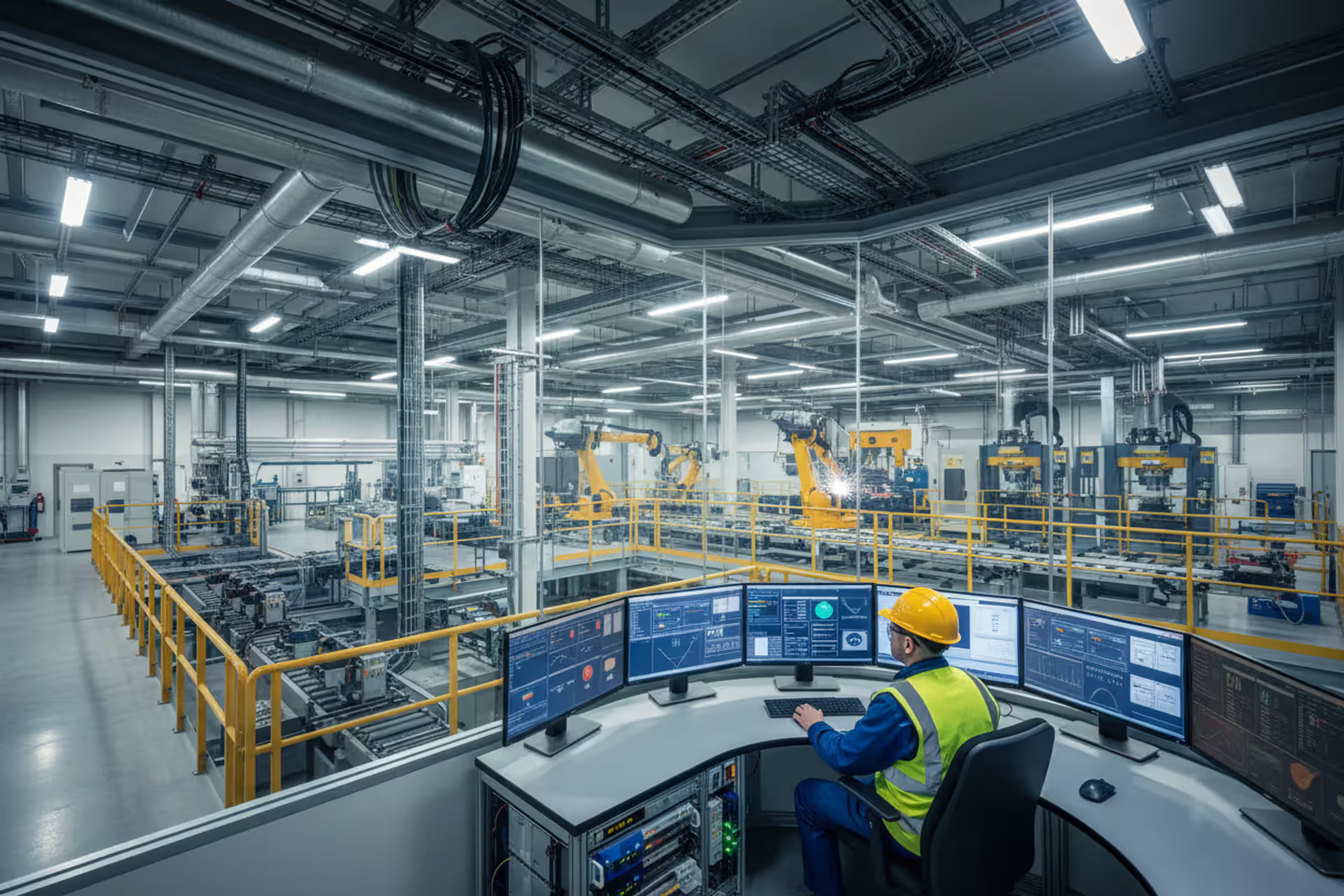
Industrial control room and plant systems with OT monitoring
OT Endpoint Security Guide

Manufacturing plants, power grids, water treatment facilities, and oil refineries rely on specialized computers and controllers that keep physical processes running. These devices—programmable logic controllers, human-machine interfaces, and field sensors—form the operational technology (OT) layer of critical infrastructure. Unlike office computers that handle emails and spreadsheets, OT endpoints control valves, turbines, robotic arms, and chemical mixers. When attackers compromise these systems, the consequences extend beyond stolen data to physical damage, environmental disasters, and threats to human safety.
OT endpoint security protects these industrial control devices from cyber threats while maintaining the reliability and uptime requirements that distinguish operational technology from traditional IT systems. The discipline requires specialized approaches because you cannot simply reboot a blast furnace to install a security patch, and a false positive that shuts down a production line costs tens of thousands of dollars per minute.
What Is OT Endpoint Security?
OT endpoint security refers to the strategies, tools, and practices that protect operational technology devices from unauthorized access, malware, and malicious manipulation. These endpoints include any device that monitors or controls physical processes in industrial environments.
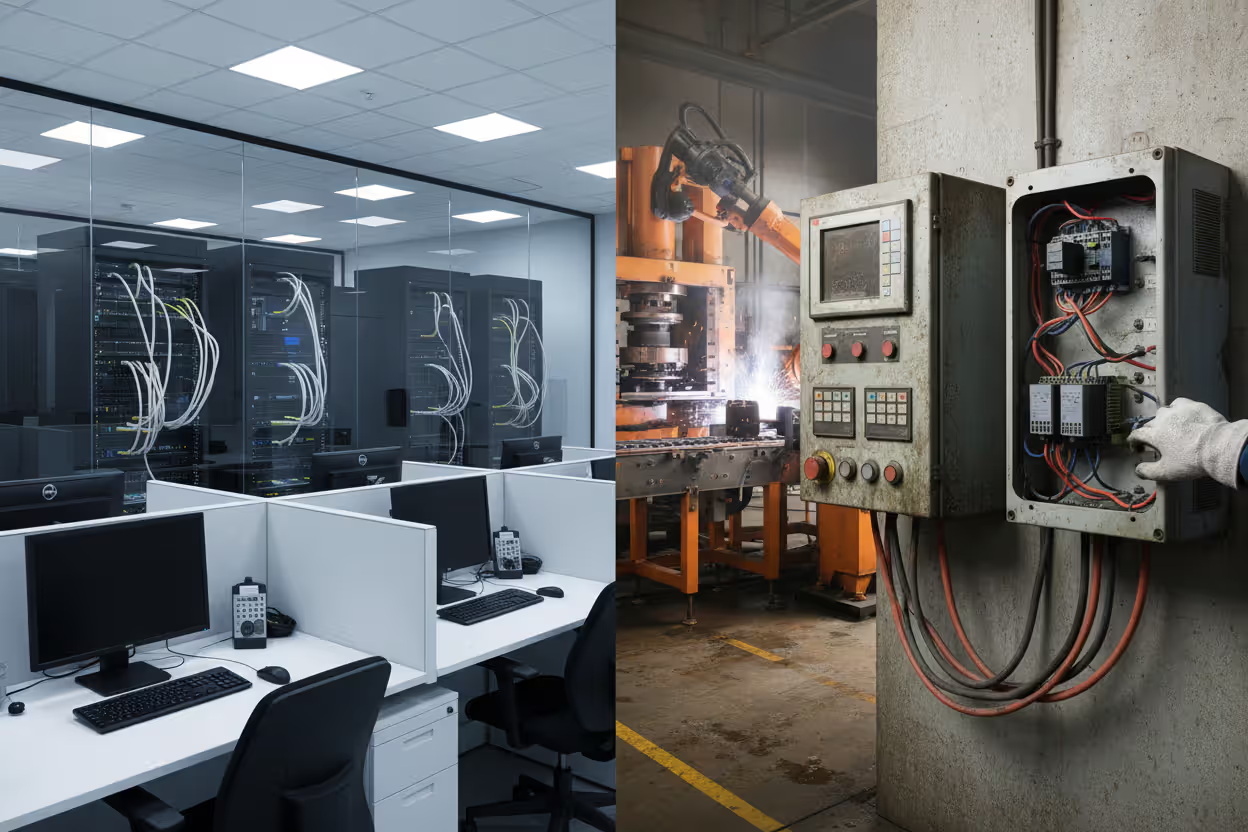
Operational technology differs fundamentally from information technology. IT systems prioritize data confidentiality—protecting customer records, financial information, and intellectual property. OT systems prioritize availability and integrity—ensuring that production lines run continuously and that control commands execute exactly as intended. An email server can tolerate a brief outage for maintenance; a chemical reactor cannot.
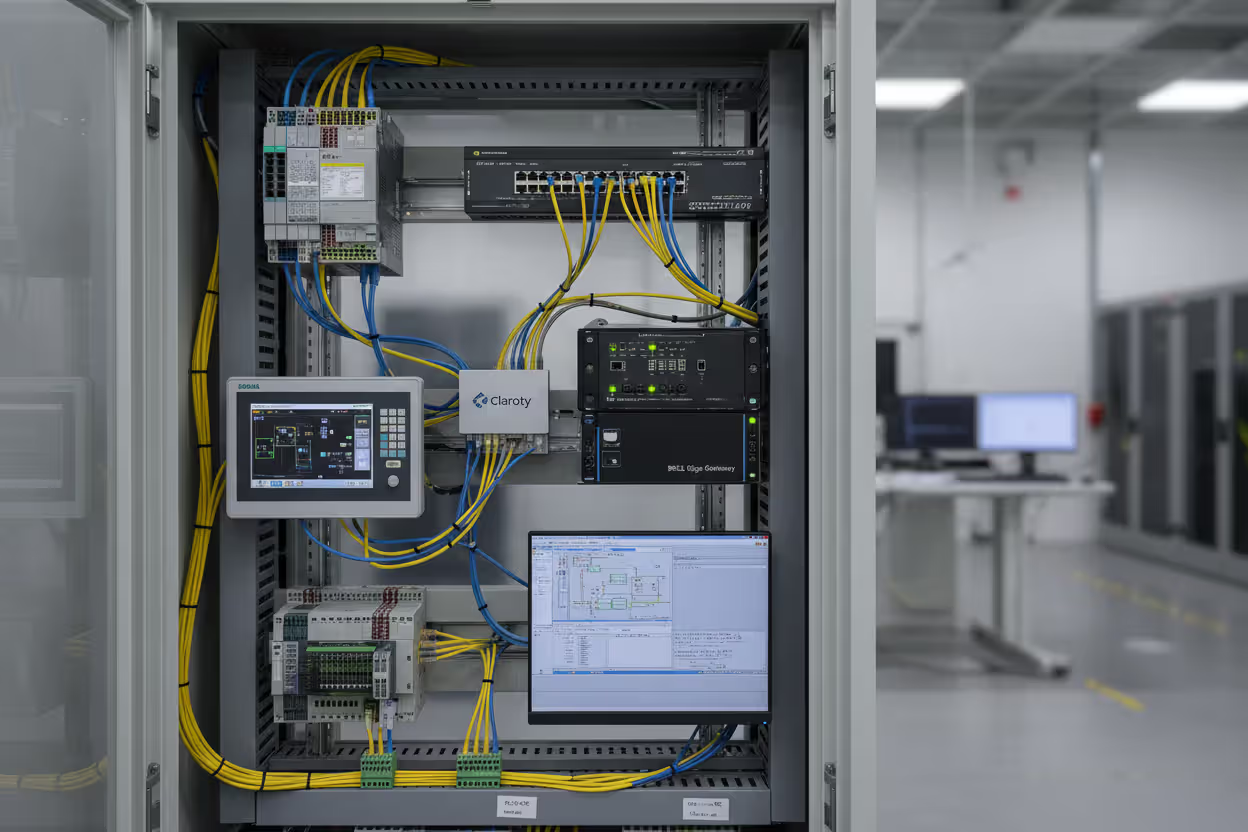
OT endpoints encompass several device categories. Programmable logic controllers (PLCs) execute control logic that opens valves, adjusts motor speeds, and sequences operations. Human-machine interfaces (HMIs) provide operators with visualization and manual control capabilities. SCADA (Supervisory Control and Data Acquisition) systems aggregate data from remote sites and coordinate distributed operations. Remote terminal units (RTUs) collect field data and execute commands in locations far from control rooms. Industrial IoT (IIoT) devices add connectivity to equipment that historically operated in isolation. Engineering workstations run the specialized software that programs and configures these control systems.
Each endpoint type presents distinct security challenges. PLCs often run proprietary operating systems with no built-in security features because they were designed decades ago when industrial networks had no internet connectivity. HMIs frequently use outdated Windows versions that manufacturers no longer support. SCADA servers may handle thousands of simultaneous connections from field devices using protocols that transmit commands without encryption or authentication. Engineering workstations require elevated privileges and specialized software that conflicts with standard security tools.
The basics of OT endpoint security start with visibility. You cannot protect devices you do not know exist, and many industrial facilities lack accurate inventories of their control systems. Passive network monitoring identifies active devices without disrupting operations, cataloging each endpoint's manufacturer, model, firmware version, network connections, and communication patterns.
Author: Ethan Caldwel;
Source: williamalmonte.net
Why OT Endpoint Security Matters for Industrial Systems
Industrial cyber incidents carry consequences that extend beyond financial losses. When attackers disrupted Colonial Pipeline operations in 2021, fuel shortages rippled across the southeastern United States. The Triton malware discovered in 2017 targeted safety instrumented systems designed to prevent explosions and toxic releases—a direct threat to human life. Manufacturing ransomware attacks idle production lines, spoil temperature-sensitive batches, and break delivery commitments that take months to repair.
The convergence of IT and OT networks has expanded the attack surface dramatically. Remote access for vendor support, cloud-connected analytics platforms, and mobile devices on the factory floor create pathways from the internet to control systems. Supply chain compromises inject malicious code into legitimate software updates and hardware components. Insider threats—whether malicious employees or contractors with excessive access—pose particular risks in environments where a single misconfigured PLC can damage expensive equipment.
Legacy systems compound the vulnerability. Many industrial facilities operate control systems installed twenty or thirty years ago, running software that predates modern security practices. Vendors may no longer exist to provide patches, and replacement costs run into millions of dollars. These systems were never designed to resist determined attackers, yet they now face nation-state threat actors and sophisticated criminal groups.
Regulatory frameworks increasingly mandate OT security controls. The North American Electric Reliability Corporation Critical Infrastructure Protection (NERC CIP) standards require electric utilities to implement specific protections for bulk electric systems. The IEC 62443 series provides comprehensive security requirements for industrial automation and control systems. The Transportation Security Administration issued cybersecurity directives for pipeline operators following the Colonial Pipeline incident. The Chemical Facility Anti-Terrorism Standards (CFATS) include cybersecurity components. Organizations that fail to meet these requirements face fines, sanctions, and potential liability in the event of incidents.
The unique characteristics of OT systems—including their longevity, proprietary nature, and safety and reliability requirements—necessitate security approaches that differ significantly from traditional IT security practices. Organizations must understand that applying IT security tools and processes directly to OT environments can introduce unacceptable risks to operations
— Cybersecurity and Infrastructure Security Agency
Insurance considerations add financial pressure. Cyber insurance carriers now scrutinize OT security controls during underwriting, and premiums reflect the risk profile of industrial operations. Some insurers exclude OT-related claims entirely without evidence of appropriate safeguards.
How OT Endpoint Security Works
OT endpoint security relies on several interconnected mechanisms that balance protection with operational requirements. Asset discovery forms the foundation—comprehensive inventories that identify every control system component, its configuration, and its network connections. Passive monitoring techniques observe network traffic without sending queries that might disrupt sensitive devices. Active scanning complements passive discovery but requires careful scheduling during maintenance windows.
Network segmentation isolates OT environments from IT networks and subdivides control systems into security zones based on criticality and function. A properly segmented architecture prevents malware from spreading laterally and limits the blast radius of successful intrusions. Firewalls between zones enforce strict rules about permitted communications—only specific devices can initiate connections, only certain protocols are allowed, and all traffic flows through inspection points.
Anomaly detection identifies deviations from established baselines. Machine learning models trained on normal operational patterns flag unusual network traffic, unexpected process changes, and suspicious user behaviors. A PLC that suddenly starts communicating with external IP addresses triggers alerts. An engineering workstation that downloads control logic outside scheduled maintenance windows requires investigation. Sensor readings that drift beyond expected ranges may indicate tampering rather than process issues.
Patch management in OT environments faces constraints that do not exist in IT. Production schedules may permit maintenance windows only during annual shutdowns. Patches require extensive testing because an incompatible update can crash critical systems. Some vendors charge substantial fees for patches or refuse to support systems beyond a certain age. Organizations must prioritize vulnerabilities based on exploitability and potential impact, applying compensating controls when patching is not feasible.
Allowlisting (formerly called whitelisting) proves more effective than blocklisting in OT environments. Rather than trying to identify all possible malicious software, allowlisting permits only explicitly approved applications, scripts, and processes to execute. This approach works well for control systems that run the same software for years without changes. Engineering workstations present challenges because they require more flexibility, but even these can restrict executable locations and file types.
Key Differences Between IT and OT Security Approaches
The table below illustrates why IT security tools and practices require significant adaptation for operational technology environments:
| Aspect | IT Endpoint Security | OT Endpoint Security |
| Primary Priority | Confidentiality, then integrity and availability | Availability and integrity, then confidentiality |
| Patching Frequency | Monthly or more often | Annually or during planned outages |
| Acceptable Downtime | Minutes to hours for non-critical systems | Zero unplanned downtime for critical processes |
| Change Management | Frequent updates and upgrades | Minimal changes; "if it works, don't touch it" |
| Security Tools | Antivirus, EDR, vulnerability scanners | Passive monitoring, allowlisting, network segmentation |
| System Lifespan | 3–5 years | 15–30 years or longer |
| Compliance Frameworks | SOC 2, ISO 27001, GDPR | NERC CIP, IEC 62443, ISA 99 |
| Risk Tolerance | Moderate; balance security with productivity | Low; safety and reliability cannot be compromised |
Common Deployment Methods
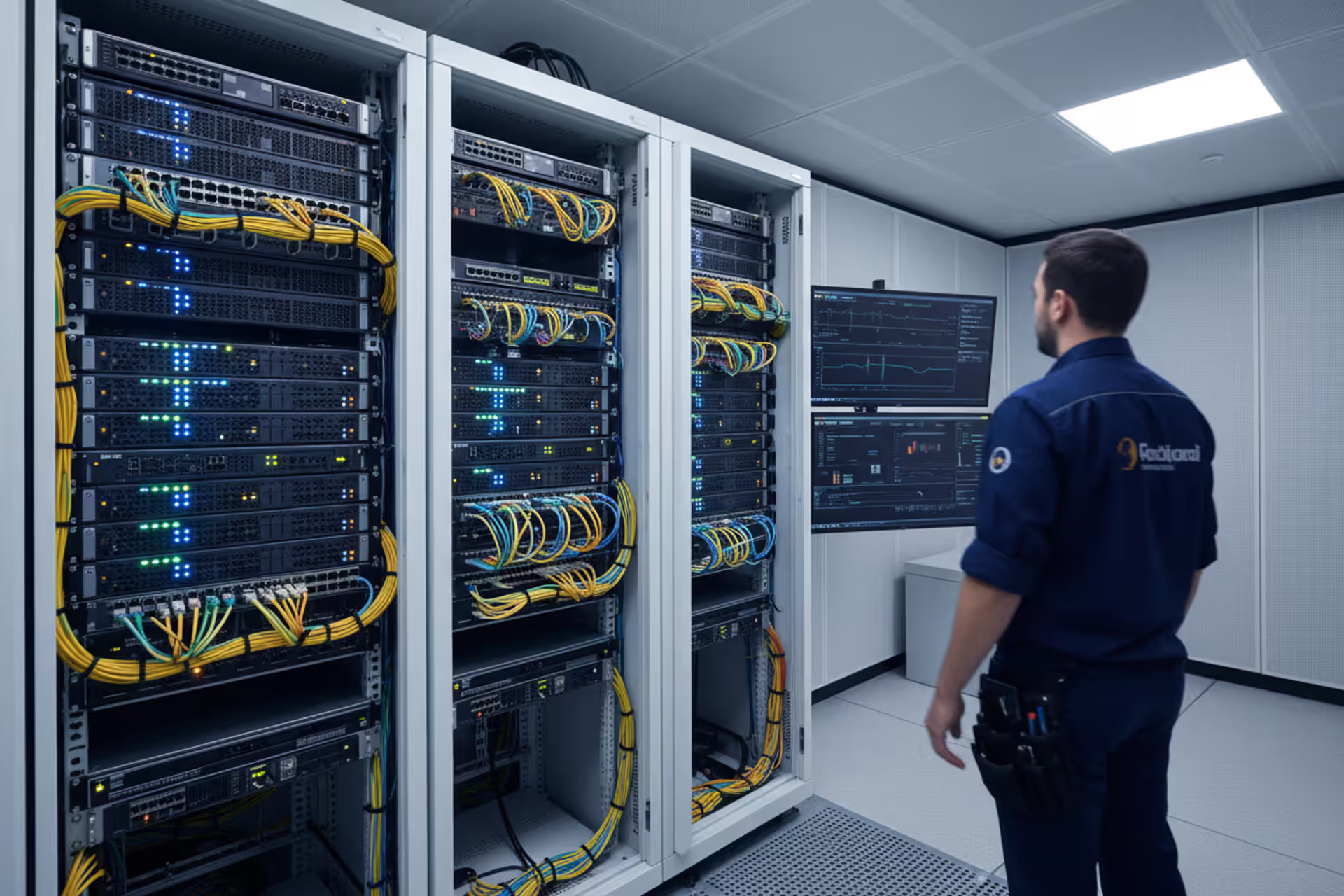
Agent-based solutions install software on endpoints to monitor processes, enforce policies, and block threats. This approach provides deep visibility and control but requires compatibility with OT operating systems and sufficient processing resources. Agents must undergo rigorous testing to ensure they do not interfere with real-time operations or consume CPU cycles needed for control functions.
Agentless solutions monitor network traffic and system behaviors without installing software on endpoints. Network taps or span ports provide copies of traffic for analysis. This approach works with legacy systems that cannot support agents and avoids any risk of impacting endpoint performance. The trade-off is less visibility into endpoint internals—you see network communications but not process execution or file system changes.
Hybrid deployments combine both methods, using agents on modern engineering workstations and servers while monitoring legacy PLCs and field devices through network analysis. Many organizations start with agentless monitoring to gain visibility and gradually introduce agents as they upgrade systems and build confidence.
Author: Ethan Caldwel;
Source: williamalmonte.net
Types of OT Endpoints That Need Protection
Industrial control systems (ICS) form the core of OT environments. These include distributed control systems (DCS) common in process industries like chemicals and refining, where thousands of control loops operate in coordination. SCADA systems manage geographically dispersed assets like pipelines, power transmission networks, and water distribution systems. Safety instrumented systems (SIS) provide independent protection layers that activate when process conditions become dangerous.
Programmable logic controllers execute the discrete and continuous control logic that drives industrial processes. A single manufacturing plant may contain hundreds of PLCs from multiple vendors, each programmed using proprietary software and communicating via industrial protocols like Modbus, Profinet, or EtherNet/IP. Examples include Allen-Bradley CompactLogix controllers managing conveyor systems, Siemens S7 PLCs controlling packaging lines, and Schneider Electric Modicon controllers operating material handling equipment.
Human-machine interfaces provide the windows into industrial processes. Panel-mounted HMIs on the factory floor display tank levels, motor statuses, and alarm conditions. Control room workstations run SCADA software that visualizes entire facilities. Mobile HMIs on tablets allow operators to monitor and adjust processes while walking through plants. These devices often run Windows operating systems with known vulnerabilities, use default passwords, and connect to both control networks and corporate IT networks.
Remote terminal units collect data from field instruments and execute control commands in locations without continuous operator presence. Electric utilities deploy RTUs at substations to monitor circuit breakers and transformers. Water utilities use RTUs at pump stations and treatment plants. Oil and gas companies install RTUs at wellheads and pipeline compressor stations. These devices communicate over cellular networks, radio links, or satellite connections—channels that attackers can intercept or spoof without physical access.
Field devices include the sensors and actuators that interact with physical processes. Smart transmitters measure pressure, temperature, flow, and level. Variable frequency drives control motor speeds. Valve positioners adjust control valves. Protective relays monitor electrical systems. Modern versions incorporate network connectivity and embedded processors that make them potential attack vectors. The Stuxnet malware famously targeted Siemens PLCs but achieved its effects by manipulating frequency converter drives.
Engineering workstations represent high-value targets because they program control systems, configure networks, and manage access credentials. Compromising an engineering workstation provides attackers with legitimate tools to modify control logic, disable safety systems, and establish persistent access. These workstations often require internet connectivity for software updates and vendor support, creating direct pathways from the outside world to control networks.

Author: Ethan Caldwel;
Source: williamalmonte.net
Common Threats Targeting OT Endpoints
Ransomware attacks have evolved from opportunistic infections to targeted campaigns against industrial organizations. Attackers research their targets, identify critical systems, and time attacks for maximum impact. Unlike IT ransomware that encrypts files, OT-focused variants may disable control systems, wipe firmware, or manipulate processes to damage equipment. Recovery requires not just decrypting data but validating that control logic has not been altered and equipment has not been physically damaged.
Supply chain compromises inject malicious code into legitimate software updates, hardware components, or vendor remote access tools. Attackers infiltrate vendors who serve multiple industrial customers, using those trusted relationships as distribution mechanisms. The SolarWinds incident demonstrated how widely a single compromised vendor can spread malware, though that particular campaign focused on IT systems rather than OT.
Insider threats in OT environments carry particular weight because insiders understand the physical processes, know which systems are critical, and possess legitimate credentials. Disgruntled employees have sabotaged production lines, former contractors have maintained unauthorized remote access, and careless insiders have introduced malware via USB drives. The 2000 Maroochy Shire incident involved a former contractor who remotely released sewage into waterways using legitimate access credentials.
Legacy system vulnerabilities provide abundant exploitation opportunities. Many industrial protocols transmit commands without authentication—any device that can reach the network can send control commands. Default passwords remain unchanged on devices installed decades ago. Undocumented features and backdoors exist in older equipment. Buffer overflows and other memory corruption bugs plague firmware that has never received security updates.
The Triton malware (also called Trisis) specifically targeted Schneider Electric Triconex safety instrumented systems used to prevent catastrophic failures at a petrochemical facility. Attackers spent months studying the proprietary control system, developing custom tools to reprogram safety controllers. Had the attack succeeded, it could have disabled emergency shutdown systems designed to prevent explosions. The sophistication demonstrated nation-state capabilities directed at causing physical destruction.
Colonial Pipeline's 2021 ransomware attack initially compromised IT systems but forced the company to shut down fuel pipeline operations as a precaution, demonstrating how IT incidents cascade into OT impacts. The attackers gained initial access through a compromised VPN password, moved laterally through the network, and deployed ransomware across business systems. Although the malware did not directly infect control systems, operators could not safely operate the pipeline without the IT systems that manage scheduling, metering, and billing.

Author: Ethan Caldwel;
Source: williamalmonte.net
Implementing OT Endpoint Security in Your Environment
Risk assessments tailored to OT environments identify critical assets, evaluate threats, and quantify potential consequences. Start by mapping dependencies—which control systems affect safety, environmental compliance, or production commitments? What happens if each system becomes unavailable for an hour, a day, or a week? Which systems, if manipulated, could damage equipment or endanger personnel?
Threat modeling considers who might attack your systems and why. Nation-state actors target critical infrastructure for espionage or sabotage. Criminal groups seek ransomware payouts. Competitors might pursue industrial espionage. Hacktivists target industries they oppose. Each threat actor brings different capabilities and motivations that influence which vulnerabilities they are likely to exploit.
Establishing behavioral baselines requires monitoring normal operations over extended periods. Control systems follow predictable patterns—the same devices communicate with the same peers, processes cycle through defined sequences, and network traffic volumes remain relatively stable. Baseline data enables anomaly detection that distinguishes genuine threats from benign changes. Collect at least thirty days of data covering different operational modes: normal production, startup, shutdown, and maintenance activities.
Selecting appropriate tools demands careful evaluation of OT-specific requirements. Can the solution operate in a read-only mode without sending packets to sensitive devices? Does it understand industrial protocols like Modbus, DNP3, and OPC? Can it scale to monitor thousands of endpoints? Does the vendor understand OT operational constraints and provide responsive support? Request proof-of-concept deployments in lab environments before introducing tools into production networks.
Maintaining operational continuity during deployment means phasing implementations, starting with monitoring and visibility before enforcing restrictions. Begin in less critical areas to build experience and refine policies. Schedule enforcement actions during maintenance windows when operators are available to respond if issues arise. Prepare rollback procedures for every change. Communicate plans to operations teams and incorporate their feedback—they understand the processes better than security teams and can identify potential problems.
Staff training requirements span multiple groups. Security teams need education about OT systems, industrial protocols, and operational constraints. Operations teams need cybersecurity awareness training focused on OT-specific threats. Maintenance technicians need secure procedures for USB drives, vendor remote access, and mobile devices. Executives need to understand the business risks and resource requirements. Cross-training programs that embed IT security personnel with operations teams and vice versa build mutual understanding.
Vendor coordination addresses the reality that many control systems require vendor support for security implementations. Engage vendors early to understand their security capabilities and limitations. Some vendors provide hardening guides, security patches, and secure remote access solutions. Others offer minimal support for aging systems. Document vendor responsibilities in contracts and service level agreements. For critical systems, consider requiring vendors to maintain spare parts and provide emergency support.
Incident response planning for OT environments requires different procedures than IT incident response. Containment strategies must account for the fact that disconnecting a control system may be more dangerous than leaving it running while compromised. Recovery procedures must validate control logic integrity before resuming operations. Coordinate with operations teams, safety personnel, and potentially external emergency responders. Conduct tabletop exercises that simulate OT-specific scenarios like control system compromises, safety system failures, and coordinated IT/OT attacks.
Frequently Asked Questions About OT Endpoint Security
OT endpoint security addresses the unique challenges of protecting industrial control systems that cannot tolerate downtime, run for decades without replacement, and control physical processes where cyber incidents translate to real-world consequences. The convergence of IT and OT networks has expanded attack surfaces while regulatory requirements and insurance considerations make adequate protection a business necessity rather than an optional enhancement.
Effective programs balance security with operational requirements through careful risk assessment, phased implementations, and tools designed specifically for OT constraints. Network segmentation isolates critical systems, anomaly detection identifies suspicious behaviors, and allowlisting prevents unauthorized code execution—all while maintaining the reliability that industrial operations demand.
The threat landscape continues to evolve as more sophisticated actors target industrial systems and the proliferation of IIoT devices expands the attack surface. Organizations that treat OT security as an afterthought or attempt to simply extend IT security tools into industrial environments face unacceptable risks. Those that invest in specialized expertise, appropriate technologies, and cross-functional collaboration between security and operations teams position themselves to defend against current threats while adapting to future challenges.
Start with visibility—you cannot protect what you do not know exists. Build from there with network segmentation, behavioral monitoring, and careful application of security controls that respect operational constraints. The goal is not perfect security, which does not exist, but rather risk reduction to acceptable levels while maintaining the availability and integrity that keep critical infrastructure and industrial processes running safely.
Related Stories
Read more
Read more



The content on this website is provided for general informational and educational purposes only. It is intended to explain concepts related to endpoint security, cybersecurity practices, threat prevention, and security technologies.
All information on this website, including articles, guides, and examples, is presented for general educational purposes. Cybersecurity requirements and implementations may vary depending on organizational needs, infrastructure, regulatory requirements, and threat environments.
This website does not provide professional cybersecurity, legal, or compliance advice, and the information presented should not be used as a substitute for consultation with qualified cybersecurity professionals.
The website and its authors are not responsible for any errors or omissions, or for any outcomes resulting from decisions made based on the information provided on this website.