

Business devices secured by endpoint protection
What Is Endpoint Protection?

Content
Content
Picture this: your marketing manager opens a laptop at a coffee shop. Your CFO checks email on an iPhone during a flight delay. A warehouse supervisor scans inventory on a tablet connected to your Wi-Fi. Every single one of these devices could become the crack attackers need to steal your data.
That's where endpoint protection comes in. Unlike the old-school antivirus software you installed and forgot about, modern endpoint security actively hunts for threats across all your connected devices. With remote teams scattered across home offices and coworking spaces, that old idea of protecting just your office network? It's dead. Now you need protection that follows your devices wherever they go.
Endpoint Protection Definition and Core Components
Here's the straightforward endpoint protection definition: it's security software that watches over every device connecting to your business systems—stopping malware, blocking suspicious behavior, and giving IT teams a bird's-eye view of what's happening across hundreds or thousands of devices simultaneously.
The endpoint protection meaning goes way beyond "antivirus 2.0." We're talking about intelligent systems that spot weird behavior, shut down attacks automatically, and learn from every threat they encounter.
So what counts as an endpoint? Basically, if it connects to your network and touches company data, it's an endpoint. Desktop towers gathering dust. MacBooks in the design department. Sales team iPhones. Android tablets on the warehouse floor. That smart TV in the conference room. Point-of-sale registers at retail locations. Even medical devices in healthcare facilities and the industrial controllers running manufacturing equipment.
Why does this matter? Because every single device can store, process, or transmit business information—making each one a potential target.
Modern endpoint protection platforms run on three foundational layers:
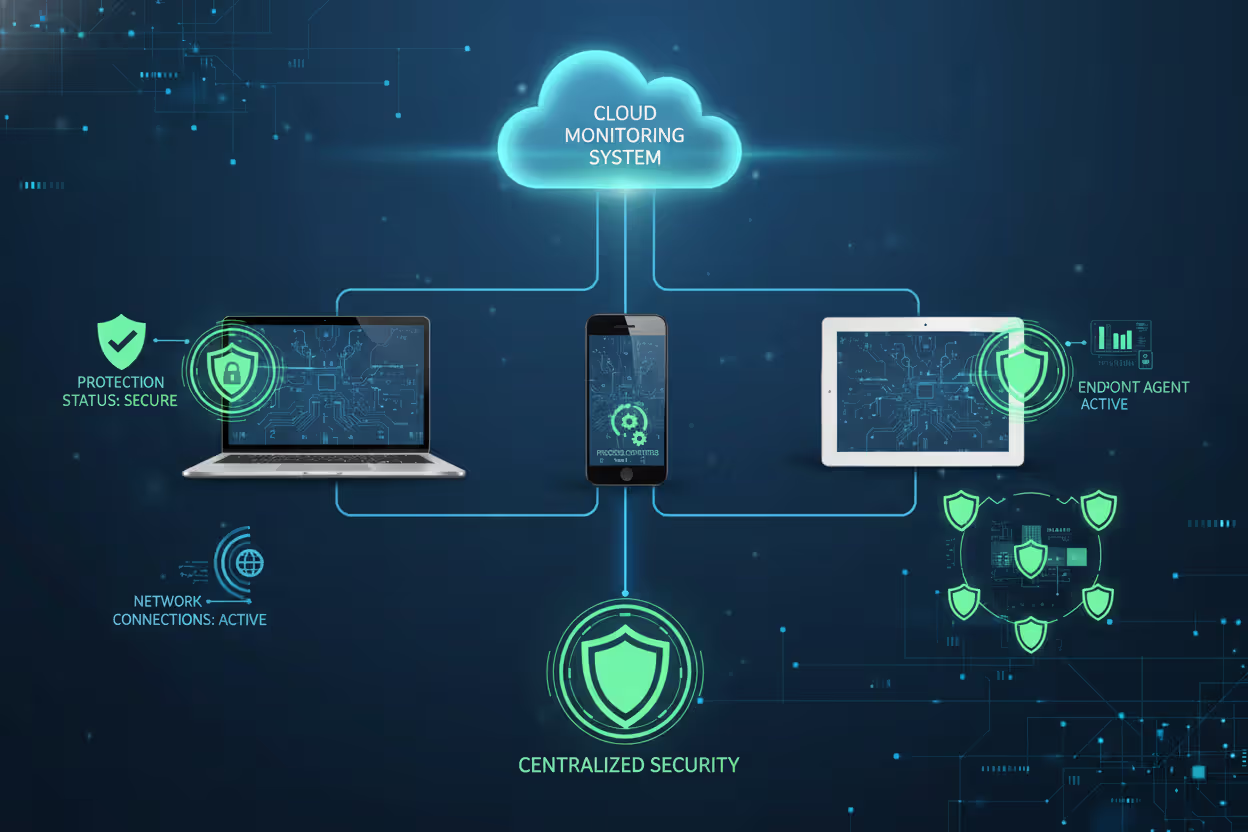
Agent software on each device: Think of this as a lightweight security guard installed directly on laptops, phones, and tablets. It watches everything—which programs launch, what files get modified, where network connections go, what changes happen in the system registry. These agents work 24/7, whether your device sits at headquarters or connects from a beach in Bali.
Author: Vanessa Keaton;
Source: williamalmonte.net
The command center dashboard: Your security team gets one unified view of everything. Deploy new policies to 5,000 devices with a few clicks. Review threat alerts from across your organization. Kick off emergency responses when something looks fishy. This console pulls together threat data and shows you exactly where your security stands right now.
Cloud-powered threat intelligence: This is the secret sauce. Machine learning algorithms trained on billions of malware samples constantly analyze patterns. When a brand-new threat emerges anywhere in the world, your endpoints can receive protection updates within minutes—no waiting for someone to manually download signature files like the old days.
But wait, there's more to the endpoint protection definition. We're also talking data loss prevention, full-disk encryption, controlling which applications can run, and fixing software vulnerabilities before attackers exploit them. Traditional antivirus never offered that depth.
How Endpoint Protection Secures Your Devices
Instead of relying on one detection method, endpoint protection platforms stack multiple techniques on top of each other. If one method misses something, another catches it.
Signature matching works like a wanted poster database. The system compares file fingerprints against libraries of known bad guys. Sure, it works great against threats we've seen before. But polymorphic malware that rewrites itself with each infection? Signature matching whiffs completely. Still, platforms keep these databases as a solid first line of defense.
Heuristic scanning examines how code is built and what it tries to do—spotting suspicious traits without needing exact matches. Say a program attempts encrypting thousands of files while phoning home to an unknown server overseas. Even if that specific ransomware variant is brand new, its behavior screams "malicious." The system flags it immediately.
Behavior tracking watches what happens when programs actually run instead of just analyzing static files. A trusted spreadsheet application suddenly trying to inject code into your operating system's core processes? That's not normal. Endpoint protection sees this deviation and can kill the process instantly—even if the spreadsheet file itself looks clean.
Machine learning engines crunch hundreds of data points simultaneously. File metadata. Network traffic patterns. Memory operations. Process relationships. The algorithms assign threat scores to everything happening on your devices, constantly improving their accuracy as they process new samples. No human intervention required for the system to adapt to attacker tactics.
When threats get detected, response kicks in immediately. Based on your configured policies, the system might isolate the suspicious file, terminate associated processes, block network communications, or roll back system changes using pre-attack snapshots. Meanwhile, security teams receive detailed forensic breakdowns showing attack timelines, compromised files, and any attempts at spreading laterally.
This endpoint protection overview shows how we've shifted from waiting for users to accidentally trip malware landmines to actively hunting for compromise indicators and suspicious patterns before damage occurs.

Author: Vanessa Keaton;
Source: williamalmonte.net
Common Use Cases for Endpoint Protection
Different industries and workplace structures face distinct security challenges that drive endpoint protection adoption.
Securing remote teams tops the list of reasons companies deploy these platforms today. Your firewall becomes irrelevant when employees connect from home routers, airport lounges, or hotel business centers. Endpoint agents ensure security policies stay consistent no matter where someone works. That account executive dialing into systems from a Miami hotel room? Same threat detection, same encryption requirements, same access controls as someone sitting in your main office.
Managing personal devices at work creates unique headaches. BYOD policies let employees use their own smartphones and tablets for work tasks, but how do you secure company data without invading personal privacy? Endpoint protection builds secure containers on these devices—work apps and data stay completely separated from personal stuff. If someone downloads a sketchy app from a third-party store that infects their phone, the \ stops that malware from touching corporate email credentials or cloud storage.
Protecting enterprise networks requires more than perimeter defenses. Even with top-tier firewalls and intrusion detection, attackers who slip through an initial phishing email need to hop between endpoints to reach your crown jewels. Endpoint protection spots this lateral movement by flagging weird authentication patterns, privilege escalation attempts, and unusual network reconnaissance activity.
Healthcare compliance demands strict control over any device touching patient records. Endpoint protection forces encryption on all devices storing medical data, maintains detailed access logs for audits, and blocks unauthorized USB drives that could siphon sensitive information. When ransomware hits a workstation at a medical practice, automatic isolation kicks in before the infection spreads to connected systems storing thousands of patient files.
Financial sector deployments deal with constant attacks from sophisticated criminals hunting transaction data and account credentials. Endpoint monitoring watches for keyloggers, screen capture tools, and memory-scraping malware designed to steal payment information mid-processing. A bank teller's workstation showing suspicious activity? The system can restrict access to core banking apps while investigators dig deeper.
Industrial and critical infrastructure protection covers operational technology endpoints controlling physical machinery. A compromised industrial controller could shut down production lines or create dangerous safety conditions. Endpoint security in these environments leans heavily on application whitelisting—only pre-approved software gets permission to execute—plus strict network segmentation that prevents malware from jumping between corporate IT and operational technology networks.

Author: Vanessa Keaton;
Source: williamalmonte.net
Key Benefits of Implementing Endpoint Protection
Organizations deploying comprehensive endpoint security see concrete improvements in both protection and efficiency.
Instant threat detection shrinks exposure windows from weeks down to minutes. Old-school periodic scans might miss active infections running between scheduled checks. Continuous monitoring catches threats the moment they try executing—before ransomware encrypts files or thieves exfiltrate data. A finance employee clicking a phishing link gets immediate intervention when the malicious payload attempts running.
Smaller attack surface comes from consistently enforcing security policies everywhere. Endpoint protection identifies unpatched software, weak configurations, and unnecessary services that attackers love exploiting. Security teams get prioritized fix-it lists showing which vulnerabilities pose the biggest risks based on active exploitation in the wild. That unpatched remote desktop service offering easy access? Flagged and disabled before attackers find it.
Unified management eliminates manually configuring security settings on individual machines. Policy changes roll out across thousands of endpoints in minutes, guaranteeing uniform protection standards. When a fresh ransomware variant appears, security teams update detection rules once in the management console instead of touching each device individually. This scalability becomes crucial as organizations grow and device counts multiply.
Simplified compliance generates required reports automatically, demonstrating security control effectiveness for auditors. Healthcare organizations prove HIPAA compliance by producing encryption enforcement logs, access control records, and incident response timelines. Banks satisfy PCI DSS requirements with documented malware protection, system monitoring, and vulnerability management activities.
Faster incident response provides forensic data that otherwise requires manual collection from compromised devices. When breaches happen, security teams access detailed timelines showing infection vectors, lateral movement paths, and data access patterns. This visibility cuts investigation time from weeks to hours, enabling quicker containment and more accurate damage assessments.
Protected productivity prevents malware-related downtime disrupting business operations. Ransomware encrypting a file server can paralyze entire departments for days. Endpoint protection blocks ransomware before encryption starts, avoiding recovery costs, productivity losses, and potential ransom payments. The endpoint protection benefits extend past security metrics into business continuity and bottom-line financial impact.
Endpoint Protection vs. Traditional Antivirus
The gap between modern endpoint security and old-school antivirus helps explain why organizations upgrade their defenses.
| Feature | Traditional Antivirus | Endpoint Protection |
| Detection Methods | Signature-based scanning matching known malware | Behavioral analysis, machine learning, threat intelligence, and signatures working together |
| Monitoring Approach | Scheduled scans plus checking files when accessed | Continuous tracking of processes, network connections, and system modifications |
| Management Style | Minimal central control; configure each device separately | Single console deploying policies, monitoring status, and managing responses across all devices |
| Response Options | Quarantine or delete infected files | Automated isolation, system rollback, threat hunting tools, and forensic investigation capabilities |
| Update Model | Installed locally with periodic manual updates | Cloud-connected agents receiving real-time threat intelligence |
| Protection Scope | Viruses, worms, and previously identified malware | Ransomware, zero-day exploits, fileless attacks, insider threats, and advanced persistent threats |
| Reporting Depth | Basic scan logs | Comprehensive audit trails, policy enforcement documentation, and incident records |
Traditional antivirus reacts after threats become known and signatures get distributed. Endpoint protection platforms anticipate threats by analyzing behavioral patterns and anomalies—catching attacks nobody's seen before. Fileless attacks executing malicious code directly in memory without writing files to disk? Traditional antivirus sees nothing. Endpoint protection's behavioral alerts light up immediately.
Management differences become obvious at scale. An IT admin handling 500 devices with traditional antivirus must verify each device gets updates, check individual logs for infections, and manually adjust settings. With endpoint protection, that same admin views the entire environment from one screen, deploys policy changes instantly, and receives aggregated threat intelligence revealing attack trends across the organization.
How to Choose the Right Endpoint Protection Solution
Selecting an appropriate platform means matching technical capabilities against your organization's specific requirements and constraints.

Author: Vanessa Keaton;
Source: williamalmonte.net
Growth capacity determines whether a solution expands alongside your business. A startup with 50 employees needs different infrastructure than an enterprise managing 10,000 endpoints across multiple continents. Cloud-based platforms typically scale more smoothly than on-premises deployments, though organizations with bandwidth constraints or data sovereignty requirements might prefer hybrid approaches. Don't just count current endpoints—project growth over the next three to five years to avoid premature replacement costs.
Integration with existing tools affects how endpoint protection fits into your broader security ecosystem. Platforms connecting with SIEM systems, firewalls, and identity providers create unified environments where threat intelligence flows between components automatically. An endpoint detecting stolen credentials should trigger password resets in your identity system plus firewall rule updates blocking the attacker's IP address—all without manual intervention.
Quality of threat intelligence varies dramatically between vendors. Examine the threat database size, update frequency, and research team credentials. Some vendors run their own threat research labs and contribute to industry vulnerability disclosures; others license third-party feeds. Request live demonstrations using recent malware samples to assess detection accuracy and false positive rates under real conditions.
System performance impact affects user experience directly. Endpoint agents consume CPU cycles, memory, and disk resources. Poorly optimized solutions cause application slowdowns, boot delays, and laptop battery drain. Test candidates in pilot deployments with realistic user workloads—developers compiling code, designers manipulating large files, sales teams running video conferences—to spot performance bottlenecks before organization-wide rollout.
Total investment analysis goes beyond licensing fees to include implementation services, ongoing support, and hidden expenses. Some vendors charge per-endpoint annually; others tier pricing by feature sets. Assess three-year ownership costs including staff training, integration effort, and possible hardware upgrades for older endpoints struggling with agent requirements. An inexpensive solution requiring extensive customization and dedicated internal staff might ultimately cost more than a premium platform bundling managed services.
Support quality during crises becomes critical when security incidents occur. Evaluate response time commitments, availability of threat research assistance, and documentation quality. Organizations lacking dedicated security teams benefit tremendously from vendors offering managed detection and response services where external analysts monitor alerts and guide incident responses.
Industry-specific compliance ensures platforms meet regulatory requirements. Healthcare needs HIPAA-compliant solutions with business associate agreements in place. Financial services require platforms supporting PCI DSS evidence collection. Government contractors must verify FedRAMP authorization or NIST framework alignment.
Endpoints have replaced the network perimeter as the primary battleground in cybersecurity. Any organization skipping comprehensive endpoint protection might as well leave their front door wide open in a neighborhood where break-ins occur daily
— Dr. Sarah Chen
Frequently Asked Questions About Endpoint Protection
Endpoint protection has transformed from basic antivirus software into comprehensive security platforms addressing today's complex threat environment. Organizations face attackers wielding sophisticated techniques—fileless malware, zero-day exploits, credential theft operations—that traditional security tools simply cannot detect. The collapse of network perimeters through remote work adoption and cloud migration makes endpoints your primary attack surface requiring protection.
Deploying endpoint security delivers measurable returns: accelerated threat detection, shortened incident response timelines, unified security management, and streamlined compliance. The investment shields against financial devastation from ransomware, data breaches, and operational disruptions while enabling secure business operations across distributed workforces.
Choosing the right platform requires evaluating scalability, integration capabilities, threat intelligence quality, and total ownership costs against your specific organizational needs. Small businesses gain from managed services delivering enterprise-grade protection without requiring dedicated security staff, while large enterprises need platforms integrating with existing security ecosystems and supporting complex policy requirements.
As cyber threats continue evolving in sophistication and frequency, endpoint protection remains the foundation of effective security strategies—providing the visibility and control necessary for defending against attacks targeting the devices where actual work happens.
Related Stories

Read more

Read more


The content on this website is provided for general informational and educational purposes only. It is intended to explain concepts related to endpoint security, cybersecurity practices, threat prevention, and security technologies.
All information on this website, including articles, guides, and examples, is presented for general educational purposes. Cybersecurity requirements and implementations may vary depending on organizational needs, infrastructure, regulatory requirements, and threat environments.
This website does not provide professional cybersecurity, legal, or compliance advice, and the information presented should not be used as a substitute for consultation with qualified cybersecurity professionals.
The website and its authors are not responsible for any errors or omissions, or for any outcomes resulting from decisions made based on the information provided on this website.