

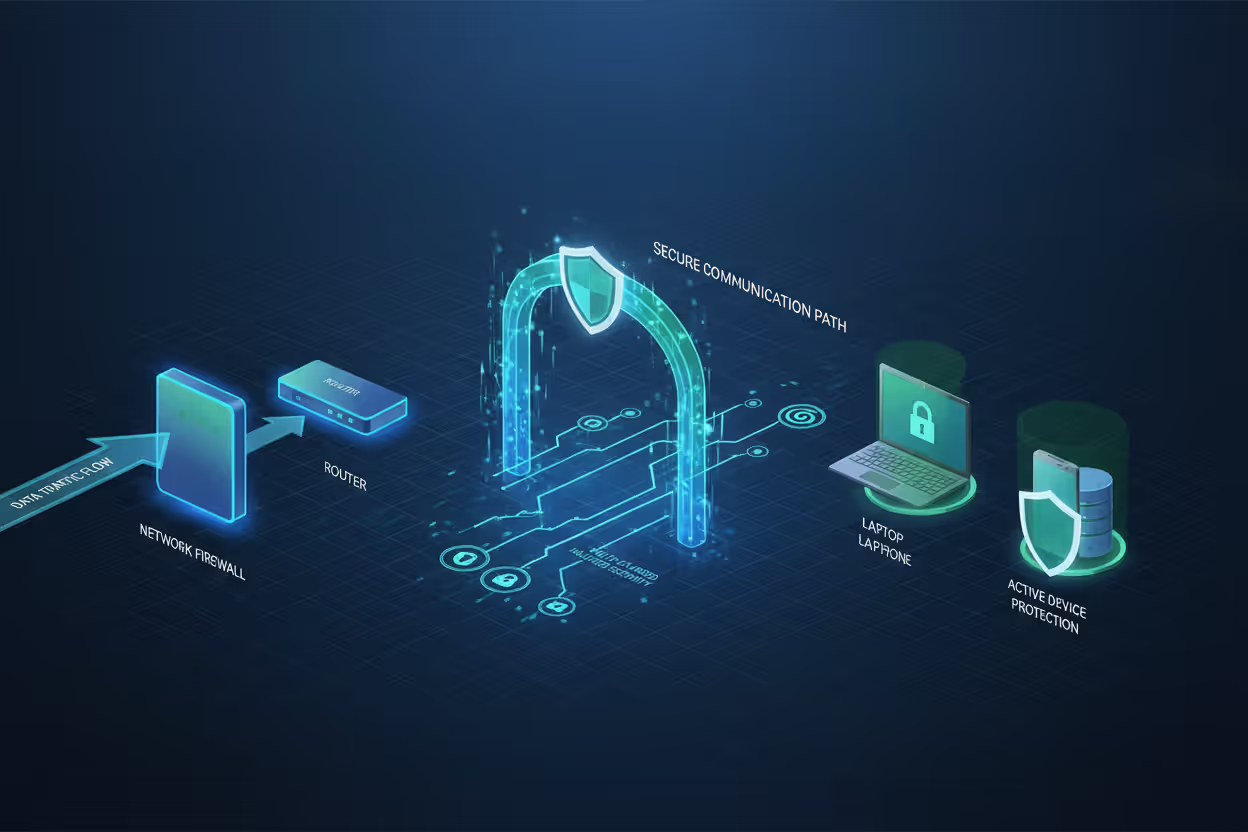
Network and endpoint security concept in a modern office environment
Network and Endpoint Security Guide

Content
Content
Organizations face a constant barrage of cyber threats that exploit vulnerabilities at multiple levels. A comprehensive defense requires protection both at the network perimeter and on individual devices. Understanding how network and endpoint security complement each other helps businesses build resilient systems that can withstand modern attacks.
What Are Network and Endpoint Security?
Network and endpoint security explained: these two security disciplines form the foundation of most organizational cybersecurity strategies. While they protect different aspects of your infrastructure, they work in tandem to create multiple defensive layers that make successful breaches significantly harder.
Network Security Overview
Network security focuses on protecting the infrastructure that connects devices and enables data flow between systems. This includes routers, switches, firewalls, and the communication channels themselves. The primary goal is to monitor and control traffic entering and leaving your network perimeter while preventing unauthorized access to network resources.
Traditional network security operated on a castle-and-moat principle: strong defenses at the boundary with relatively open access inside. Modern approaches recognize that threats can originate internally or bypass perimeter defenses entirely, requiring more sophisticated monitoring throughout the network fabric.
Network security tools inspect packet headers, analyze traffic patterns, and enforce policies based on IP addresses, ports, and protocols. They can block malicious traffic before it reaches internal systems, throttle suspicious connections, and segment networks to limit lateral movement if attackers gain a foothold.
Endpoint Security Overview
Endpoint security protects individual devices—laptops, desktops, servers, mobile phones, and increasingly IoT devices—that connect to your network. Each endpoint represents a potential entry point for attackers, especially as remote work and BYOD policies expand the attack surface beyond traditional office environments.
Unlike network security which monitors traffic flow, endpoint security operates directly on devices. It monitors application behavior, file system changes, registry modifications, and process execution. Modern endpoint protection detects threats based on behavior patterns rather than just known signatures, catching zero-day exploits and polymorphic malware that evade traditional antivirus.
The relationship between these two security domains is complementary. Network security provides visibility into communication patterns and can block threats before they reach endpoints. Endpoint security catches threats that slip through network defenses or originate from legitimate-looking traffic. A remote employee opening a phishing email on their home network bypasses your network security entirely—only endpoint protection stands between that malicious attachment and a full system compromise.
Author: Daniel Prescott;
Source: williamalmonte.net
How Network and Endpoint Security Works
Network and endpoint security basics involve multiple detection and prevention mechanisms working simultaneously. Understanding these technical foundations helps you evaluate solutions and troubleshoot issues when they arise.
Network security begins at the perimeter with firewalls that enforce access control lists. These rules determine which external addresses can initiate connections to internal resources and on which ports. Stateful inspection firewalls track connection states, ensuring response packets match legitimate outbound requests rather than representing unsolicited inbound attacks.
Intrusion detection systems (IDS) and intrusion prevention systems (IPS) add another layer by analyzing packet contents against known attack signatures. An IDS alerts administrators to suspicious activity; an IPS actively blocks it. Deep packet inspection examines payload data, not just headers, catching attacks hidden in seemingly legitimate traffic.
Web application firewalls (WAF) specifically protect web servers by filtering HTTP traffic. They block SQL injection attempts, cross-site scripting, and other application-layer attacks that traditional network firewalls might miss. DNS filtering prevents users from reaching known malicious domains, stopping command-and-control communications before they establish.
Endpoint security works through agents installed on each device. These agents monitor system calls, file operations, network connections, and process behavior in real-time. When a user downloads a file, the agent scans it against malware signatures. When an application attempts unusual behavior—like a Word document spawning PowerShell processes—behavioral analysis flags it as potentially malicious.
Endpoint detection and response (EDR) platforms collect telemetry from all endpoints, correlating events across devices to identify attack campaigns. If one laptop shows signs of credential dumping while another exhibits lateral movement attempts, EDR connects these dots even when individual events seem benign in isolation.
Application control (whitelisting) prevents unauthorized software from executing. Instead of trying to identify all bad programs, you specify which programs are allowed—anything else simply won't run. This approach stops zero-day exploits cold but requires careful management to avoid blocking legitimate tools.
Disk encryption protects data at rest, ensuring stolen laptops don't expose sensitive information. Full-disk encryption scrambles entire drives; file-level encryption protects specific documents. Both require proper key management—losing encryption keys means losing data permanently.

Author: Daniel Prescott;
Source: williamalmonte.net
The coordination between network and endpoint security happens through threat intelligence sharing. When endpoint security detects a new malware variant, it can share indicators of compromise (IOCs) with network security tools. Firewalls then block traffic to command-and-control servers associated with that malware. Conversely, when network monitoring spots suspicious traffic patterns, endpoint tools can investigate the source device more deeply.
Key Differences Between Network and Endpoint Security
While network and endpoint security work together, they differ fundamentally in approach, scope, and the threats they address most effectively.
| Feature | Network Security | Endpoint Security |
| Primary Focus | Traffic flow and communication between systems | Individual device behavior and local threats |
| Protection Layer | Perimeter and internal network segments | Operating system, applications, and data on devices |
| Common Tools | Firewalls, IDS/IPS, VPN gateways, network access control (NAC) | Antivirus, EDR, application control, disk encryption |
| Threat Types Addressed | DDoS attacks, man-in-the-middle, network scanning, unauthorized access | Malware, ransomware, fileless attacks, data exfiltration |
| Deployment Location | Centralized at network boundaries and distribution points | Distributed across every device connecting to the network |
Network security excels at stopping threats before they reach your systems. A properly configured firewall prevents entire categories of attacks by blocking unnecessary ports and protocols. Network segmentation contains breaches, preventing attackers who compromise one system from easily pivoting to others.
Endpoint security catches threats that bypass network defenses or originate from trusted sources. Phishing emails from compromised legitimate accounts pass network security checks because the sender appears valid. Malicious USB drives plugged directly into computers never touch the network. Remote workers on coffee shop WiFi need endpoint protection since your network security can't help them.
The scope difference matters for incident response. Network security logs show what happened between systems but not what occurred on the systems themselves. Endpoint logs reveal which files were accessed, which processes ran, and what data was modified—critical for forensic analysis and recovery.
Deployment complexity varies significantly. Network security typically involves fewer, more powerful devices at strategic points. Endpoint security requires managing agents on potentially thousands of devices with varying operating systems, patch levels, and user privileges. A misconfigured firewall impacts everyone; a misconfigured endpoint agent only affects that device.
Common Network and Endpoint Security Threats
Real-world network and endpoint security examples illustrate why both protection types are necessary and how attacks exploit gaps in either domain.
Distributed Denial of Service (DDoS) attacks overwhelm network infrastructure with traffic from thousands of compromised devices. The 2024 attacks on major cloud providers demonstrated how volumetric attacks can saturate internet connections regardless of endpoint security. Network-based DDoS mitigation services filter malicious traffic before it reaches your infrastructure, but endpoints can't defend against network-level resource exhaustion.
Ransomware represents the inverse scenario—a primarily endpoint-focused threat that network security struggles to prevent. Modern ransomware variants like those from the LockBit and BlackCat families encrypt files locally after users open malicious attachments or visit compromised websites. While network security might block command-and-control communications, the damage occurs at the endpoint before network tools even see suspicious traffic. EDR solutions detect the rapid file modification patterns characteristic of ransomware and can halt encryption before it spreads.
Phishing campaigns exploit both domains. The initial delivery often bypasses network security because emails come from legitimate servers and contain no malware initially. Users click links leading to credential harvesting sites or download seemingly innocent documents. Endpoint security catches malicious macros or scripts embedded in those documents, but if users manually enter credentials on fake websites, only network security analyzing traffic patterns might notice connections to known phishing infrastructure.
Man-in-the-middle attacks target network communications specifically. Attackers intercept traffic between two parties, reading or modifying data in transit. Public WiFi networks are notorious for this. Network security using encrypted VPN tunnels prevents eavesdropping by encrypting all traffic between endpoints and trusted networks. Endpoint security can't solve this problem alone—once data leaves the device unencrypted, endpoint tools have no control over network transmission.
Fileless malware lives entirely in memory, never writing to disk where traditional antivirus might scan it. These attacks exploit legitimate system tools like PowerShell or WMI to execute malicious code. Network security might notice unusual outbound connections, but behavioral analysis at the endpoint level is essential for detecting the malicious use of legitimate tools. The 2025 surge in living-off-the-land attacks highlighted this gap in traditional security approaches.
Insider threats bypass network security by definition since malicious insiders already have authorized access. An employee copying sensitive files to a USB drive or exfiltrating data through approved cloud services doesn't trigger network alarms designed to block external attackers. Endpoint security with data loss prevention (DLP) capabilities monitors file operations and blocks unauthorized transfers regardless of network permissions.
Supply chain compromises demonstrate how sophisticated attacks exploit trust relationships. The SolarWinds-style attacks of recent years involved legitimate software updates that contained malicious code. Network security allowed the updates through because they came from trusted vendors. Endpoint security eventually detected unusual behavior, but only after the malware executed. This scenario requires both layers: network monitoring for anomalous communications and endpoint detection for suspicious process behavior.
Essential Components of a Strong Security Strategy
Building effective network and endpoint security requires specific tools and practices that address different threat vectors and operational requirements.
Next-generation firewalls (NGFW) go beyond simple packet filtering to include application awareness, integrated intrusion prevention, and encrypted traffic inspection. Unlike traditional firewalls that operate at network layers 3-4, NGFWs understand application-layer protocols. They can distinguish between legitimate HTTPS traffic and malware using HTTPS to hide communications. Rule-of-thumb: configure NGFWs to deny all traffic by default, then explicitly allow only necessary services—the opposite approach leaves too many gaps.
Endpoint detection and response platforms collect and correlate security telemetry from all devices. EDR tools record process execution, network connections, file modifications, and registry changes. When investigating an incident, this historical data shows exactly what happened and when. Deploy EDR to all endpoints, not just high-value targets—attackers often compromise low-privilege devices first, then pivot to valuable systems.
Virtual private networks create encrypted tunnels protecting data in transit. Remote workers connecting through VPNs ensure that their communications with corporate resources remain confidential even on untrusted networks. Split-tunnel VPNs route only corporate traffic through the tunnel, improving performance for general internet use. Full-tunnel VPNs route everything through corporate networks, providing complete visibility but potentially creating bandwidth bottlenecks.
Email security gateways filter messages before they reach user inboxes. They scan attachments, analyze sender reputation, and detect phishing attempts. Advanced systems use machine learning to identify subtle indicators of business email compromise—slight domain misspellings, unusual sending patterns, or language inconsistencies. Email remains the primary attack vector, making this component essential despite endpoint protection.
Antivirus and anti-malware still matter despite sophisticated threats. Modern solutions use behavioral analysis and machine learning alongside signature detection. They catch commodity malware that EDR might consider too common to alert on. Deploy enterprise antivirus with centralized management—consumer products lack the visibility and control needed for organizational security.
Access control systems enforce the principle of least privilege. Network access control (NAC) verifies device compliance before allowing network connections. If a laptop lacks current patches or has disabled security software, NAC quarantines it to a remediation network until issues are resolved. Multi-factor authentication (MFA) prevents credential theft from granting attackers easy access—even stolen passwords become useless without the second factor.
Security information and event management (SIEM) aggregates logs from all security tools, correlating events to identify attacks. A single failed login attempt means nothing; thousands of failed attempts across multiple accounts suggest a brute-force attack. SIEM platforms apply rules and machine learning to detect patterns that individual tools miss. The trade-off: SIEM systems require significant tuning to reduce false positives while catching real threats.
Patch management keeps systems updated against known vulnerabilities. Attackers exploit unpatched systems within hours of vulnerability disclosure. Automated patch management tools deploy updates on schedules that balance security urgency against operational stability. Critical patches should deploy within days; less severe updates can wait for monthly maintenance windows. Test patches in non-production environments first—occasionally updates break legitimate functionality.
Data backup and recovery provides the last line of defense when prevention fails. Ransomware encrypts files, but backups let you restore without paying. Follow the 3-2-1 rule: three copies of data, on two different media types, with one copy offsite. Test restore procedures regularly—untested backups fail when you need them most.
Implementation Steps for Small and Medium Businesses

Author: Daniel Prescott;
Source: williamalmonte.net
Practical network and endpoint security guide for organizations without dedicated security teams or unlimited budgets.
Assess your current security posture. Document all devices connecting to your network, including servers, workstations, mobile devices, and IoT equipment. Identify what data you store, where it lives, and who accesses it. List current security tools and their configurations. Many businesses discover forgotten devices or shadow IT during this process—those represent unprotected attack surfaces. Use free vulnerability scanners to identify obvious weaknesses before investing in solutions.
Prioritize based on risk. You can't fix everything immediately. Focus first on protecting critical assets—customer data, financial records, intellectual property. Consider both likelihood and impact. A successful ransomware attack might be more likely than targeted espionage, but espionage could cause greater long-term damage. Small businesses often face commodity attacks (automated scans for common vulnerabilities) rather than targeted campaigns, so strong fundamentals matter more than exotic defenses.
Start with network security fundamentals. Deploy a business-class firewall with intrusion prevention enabled. Consumer routers lack the features and support needed for business security. Configure the firewall to block all inbound traffic except services you explicitly need—web servers, email, VPN. Disable unused services on all devices; every open port is a potential entry point. Segment networks so guest WiFi, employee devices, and servers sit on separate VLAMs with firewall rules controlling traffic between them.
Deploy endpoint protection to all devices. Choose an endpoint security solution appropriate for your size. Managed detection and response (MDR) services handle monitoring and response for businesses without security staff. Install agents on every device before it connects to your network—including executive laptops that "don't have time" for security software. Configure automatic updates so agents stay current without manual intervention.
Implement strong authentication. Require complex passwords (12+ characters, mixed types) and enable multi-factor authentication on all critical systems. Password managers help users maintain unique passwords for each service without resorting to sticky notes. For small businesses, cloud-based identity providers like Microsoft 365 or Google Workspace include MFA capabilities without additional cost.
Establish backup procedures. Automated daily backups of critical data should run without manual intervention. Store backups offline or in immutable storage that ransomware can't encrypt. Cloud backup services provide geographic redundancy and professional management at reasonable costs. Document restore procedures and test them quarterly—a backup you can't restore is worthless.
Train employees on security awareness. Most breaches involve human error—clicked phishing links, weak passwords, lost devices. Monthly security tips, simulated phishing exercises, and clear reporting procedures help employees become security assets rather than liabilities. Keep training practical: show them what phishing emails look like, explain why updates matter, demonstrate proper password practices.
Monitor and maintain continuously. Security isn't a one-time project. Review firewall logs weekly for unusual patterns. Verify backups completed successfully. Check that endpoint agents are running on all devices. Apply patches monthly at minimum, more frequently for critical vulnerabilities. Many small businesses outsource monitoring to managed security service providers (MSSPs) who watch for threats 24/7 at a fraction of the cost of in-house staff.
Document everything. Write down your security policies, tool configurations, and incident response procedures. When something breaks at 2 AM, documentation helps whoever is troubleshooting. When auditors or insurance companies ask about your security practices, documentation proves compliance. Keep documentation updated as your environment changes.
Common mistakes to avoid: Don't assume cloud services eliminate your security responsibilities. Shared responsibility models mean you still protect data, accounts, and access controls. Don't rely solely on vendor default configurations—they prioritize compatibility over security. Don't skip security because you're "too small to target"—automated attacks don't discriminate by company size. Don't treat security as an IT problem alone—it requires executive support and organizational commitment.
The integration of network and endpoint security creates a defense-in-depth strategy that significantly reduces the window of opportunity for attackers. Organizations that deploy both technologies in concert see 60% faster threat detection and 40% lower breach costs compared to those relying on either approach alone
— Sarah Chen
Frequently Asked Questions
Effective cybersecurity requires protecting both the network infrastructure that connects systems and the individual endpoints where work actually happens. Network security establishes perimeter defenses and monitors traffic flow, while endpoint security protects devices from threats that bypass or originate inside those perimeters. Neither approach alone provides adequate protection against modern cyber threats.
Small and medium businesses can implement robust security without enterprise budgets by focusing on fundamentals: business-class firewalls, comprehensive endpoint protection, strong authentication, regular backups, and employee training. Managed security services extend the capabilities of organizations without dedicated security staff.
The threat landscape continues evolving, with attackers constantly developing new techniques to bypass defenses. Regular assessment, continuous monitoring, and prompt patching help organizations stay ahead of threats. Security isn't a destination but an ongoing process of improvement and adaptation. Organizations that treat network and endpoint security as complementary investments rather than competing options build resilient systems capable of withstanding the attacks they'll inevitably face.
Related Stories

Read more

Read more




The content on this website is provided for general informational and educational purposes only. It is intended to explain concepts related to endpoint security, cybersecurity practices, threat prevention, and security technologies.
All information on this website, including articles, guides, and examples, is presented for general educational purposes. Cybersecurity requirements and implementations may vary depending on organizational needs, infrastructure, regulatory requirements, and threat environments.
This website does not provide professional cybersecurity, legal, or compliance advice, and the information presented should not be used as a substitute for consultation with qualified cybersecurity professionals.
The website and its authors are not responsible for any errors or omissions, or for any outcomes resulting from decisions made based on the information provided on this website.