

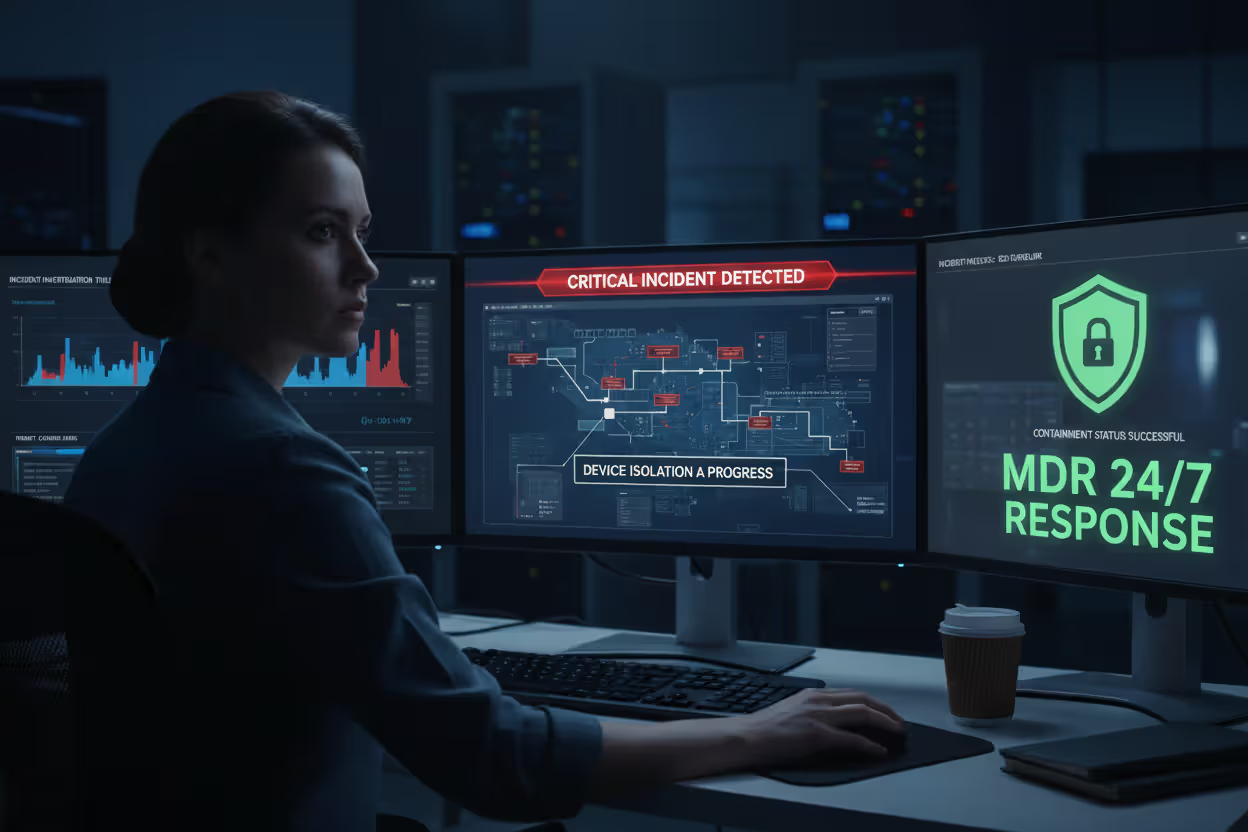
Cybersecurity team monitoring endpoint protection dashboards in a modern office
MDR vs EDR Comparison Guide

Your endpoints need protection, but the real question isn't just about technology—it's about who watches over that technology when threats emerge at 3 AM. Endpoint Detection and Response (EDR) software gives you the tools. Managed Detection and Response (MDR) services give you the tools plus a team of experts running them around the clock.
This matters because deploying security software is the easy part. The hard part? Having someone skilled enough to investigate the 200 alerts that pop up each day, determine which three represent actual threats, and stop attackers before they encrypt your file servers or steal customer data.
Companies with dedicated security operations centers often want direct control through EDR platforms. Businesses without full-time threat analysts typically need MDR services to handle what their lean IT teams simply can't manage alongside everything else.
What Are EDR and MDR Solutions?
Let's start with clear definitions, because vendors love blurring these lines during sales pitches.
Understanding Endpoint Detection and Response (EDR)
EDR software lives on your devices—every laptop, server, and workstation. It watches everything: which programs launch, what files they touch, where they connect over the network, what registry keys they modify. Think of it as a flight recorder that captures every action on your endpoints.
When something suspicious happens—say, Excel suddenly starts encrypting files in rapid succession—the EDR platform flags it. Your security team gets an alert. They investigate the timeline, check whether it's malicious or just someone batch-converting documents, then decide how to respond. Maybe they kill the process remotely. Maybe they isolate the machine from the network. Maybe they determine it's nothing.
The technology is sophisticated. Some platforms can automatically quarantine threats based on behavioral patterns. Others let analysts hunt through months of historical data to find hidden attackers. But here's the thing: EDR doesn't investigate itself. It doesn't decide whether that weird PowerShell script is dangerous or benign. Your people do that work.

Author: Marcus Halbrook;
Source: williamalmonte.net
Understanding Managed Detection and Response (MDR)
MDR flips the model. Instead of buying software and figuring out how to use it, you're hiring a security operations team that comes with the technology included.
These providers run security operations centers staffed by analysts who've spent years studying how attackers operate. When your endpoints generate alerts, their analysts investigate immediately—whether it's Tuesday afternoon or Saturday at 2 AM. They distinguish real threats from false alarms, contain confirmed incidents, and send you reports explaining what happened and what you need to fix.
Some MDR providers bring their entire technology stack. Others will monitor the EDR tools you've already bought. The defining characteristic: you're purchasing a service that delivers results ("we stopped this ransomware attack") rather than software that requires your team to deliver those results.
Core Differences Between MDR and EDR
Here's where the mdr vs edr differences get concrete. EDR is software you operate. MDR is a service someone operates for you.
When you buy EDR, you get licenses, installation guides, and maybe some training. Then your team needs to deploy agents across every endpoint, configure detection policies, tune alert thresholds to avoid drowning in false positives, and staff someone to monitor the console. Every alert that fires becomes your team's problem to investigate.
When you buy MDR, the provider handles deployment, monitoring, and investigation. You define what responses they're authorized to take (can they isolate infected machines automatically, or do they need your approval?). Then they operate the service while you receive incident reports and remediation guidance.
| Dimension | EDR | MDR |
| What You're Buying | Software license | Managed security service |
| Who Investigates Alerts | Your security team | Provider's SOC analysts |
| Threat Hunting | Your analysts must conduct hunts | Included in service package |
| When Threats Get Addressed | During your team's working hours | Continuous 24/7 coverage |
| Staff You Need | Experienced security analysts | Minimal security expertise required |
| Scaling Response Capacity | Hire more analysts | Provider adds resources as needed |
| Monitoring Coverage | Gaps during nights/weekends unless you staff multiple shifts | Round-the-clock with defined response times |
| How You Pay | Software fees plus analyst salaries | Per-endpoint or per-user subscription |
| Decision Authority | Complete control over every policy | Joint control within agreed boundaries |
| Getting It Running | Your team handles deployment and tuning | Provider manages implementation |
The mdr vs edr key distinctions become obvious when alerts start flowing. Picture this: your EDR flags 300 events overnight. Someone needs to review each one, correlate them with other security data, research suspicious file hashes, and determine which require immediate action. With EDR alone, those 300 alerts wait in a queue until your analyst arrives at 8 AM. With MDR, specialists triaged them overnight and escalated the two that actually matter.
How MDR and EDR Work in Practice
Let's walk through real scenarios to see how mdr vs edr explained translates to daily operations.
How EDR Actually Works:
Thursday at 11:47 PM, your EDR agent detects unusual activity on a marketing manager's laptop. Someone's using Mimikatz—a tool that extracts passwords from memory. The alert fires and lands in your SIEM queue. Your security analyst arrives Friday morning at 8 AM, starts working through overnight alerts, reaches this one around 9:15 AM, and recognizes Mimikatz immediately. She isolates the laptop and starts investigating.
But here's the problem: nine and a half hours passed. If that was an actual attacker, they had all night to steal credentials, move to other systems, and establish persistence. Your EDR spotted the activity instantly—the delay was purely about getting a human to look at the alert and act on it.
This isn't a failure of technology. It's the reality of EDR's operational model. Unless you staff security analysts 24/7 (which costs $500,000+ annually for a small team), you'll have gaps where threats are detected but not addressed.
How MDR Actually Works:
Same scenario—Mimikatz detected at 11:47 PM Thursday. This time, an MDR analyst in a different time zone gets the alert within minutes. He reviews the endpoint telemetry, checks whether this laptop should be running security tools (it shouldn't—marketing doesn't do pen testing), verifies the suspicious process against threat intelligence, and confirms it's credential theft malware.
At 11:58 PM—eleven minutes after detection—he isolates the laptop from your network and sends you a notification with incident details. When your IT team arrives Friday morning, the threat's already contained and documented. They can focus on remediation instead of emergency response.
The speed difference comes from continuous human attention. MDR providers staff analysts across time zones specifically so security expertise is always available, not just during business hours. These analysts also build specialized knowledge because investigating threats is their full-time job, not something they squeeze between other IT tasks.
Author: Marcus Halbrook;
Source: williamalmonte.net
When to Choose EDR Over MDR
EDR becomes the right answer when specific circumstances align around capability, control, and cost.
Your Security Team Has Real Depth:
If you employ people who previously worked as threat hunters, incident responders, or SOC analysts at companies with mature security programs, EDR tools amplify their existing skills. A financial services firm with a five-person security team—including analysts who've investigated nation-state intrusions—doesn't need external help understanding threats. They need powerful tools they can wield directly.
Compliance or Policy Requires Internal Control:
Healthcare organizations handling research data sometimes face requirements that security operations stay entirely in-house. Defense contractors with facility clearances can't grant external providers access to their networks. Pharmaceutical companies protecting drug development data may have policies against sharing security telemetry with third parties. EDR keeps everything internal.
Your Budget Structure Favors Capital Spending:
Some organizations find it easier to justify $50,000 for EDR licenses than $15,000 monthly for MDR services, even though the MDR annual cost is higher. This often happens in government agencies or enterprises with budget categories that separate technology purchases from service contracts. If you're already paying security analysts and have capital budget for tools, EDR might fit your financial planning better.
You Need Deep Customization:
A software company built their entire infrastructure on Kubernetes containers with custom service mesh configurations. Their threat profile is unique—they worry about supply chain attacks targeting their build pipeline more than typical endpoint threats. They need detection rules tailored to their specific architecture. EDR platforms give them direct access to configure complex logic that matches their environment precisely. MDR providers can customize too, but you're requesting changes rather than implementing them yourself.
Real-world example: A 400-person technology company maintains a three-person security team led by someone who spent five years hunting advanced persistent threats at a Fortune 500. They deployed EDR across all endpoints and wrote custom detection rules for their cloud-native architecture. Their team handles investigations during business hours. They accept overnight gaps, but they've implemented automation that contains obvious threats like ransomware without human intervention.
When to Choose MDR Over EDR
MDR solves problems that software alone can't address—specifically around expertise availability and specialized knowledge.
You Don't Have Dedicated Security Analysts:
A law firm with 150 employees has an IT director and two technicians who handle everything from email problems to server maintenance. When they deployed EDR, the tool generated security alerts that nobody had time or training to investigate properly. Alerts piled up unreviewed. When their cyber insurance carrier audited them, they found dozens of flagged incidents that were never addressed. MDR transformed security from an impossible responsibility into a managed function handled by specialists.
Threats Don't Respect Business Hours:
Most attacks happen outside normal business hours because attackers know security teams aren't watching. Staffing just one 24/7 position requires five full-time employees (covering weekends, holidays, sick days, and vacation). For three shifts, you need at least fifteen people plus management. That's over $1 million annually in salary alone before training, benefits, and tools. MDR delivers round-the-clock coverage for a fraction of that investment.
Advanced Threats Require Specialized Knowledge:
Recognizing sophisticated attacks takes expertise that develops over years of focused work. When North Korean threat actors target cryptocurrency companies, they use techniques that generic security training never covers. When ransomware groups exploit zero-day vulnerabilities in remote desktop software, identifying the attack requires knowledge of specific threat actor patterns. MDR providers concentrate this expertise—their analysts specialize in tracking particular threat actor groups and attack methods that individual companies can't justify studying full-time.
You Need Protection Fast:
Building an EDR program from scratch means planning the rollout, testing deployment methods, establishing policies, tuning detection rules, training staff, creating incident response playbooks, and rehearsing procedures. This takes three to six months if you have experienced staff. MDR providers handle deployment as part of service onboarding, often achieving full coverage in two to three weeks. Organizations facing audit deadlines or responding to board concerns about ransomware need this acceleration.
We tried hiring security analysts for eighteen months. We interviewed dozens of candidates, made offers to three, and all declined or accepted other positions before their start dates. The local job market for security talent was impossible. MDR gave us access to experienced analysts immediately—people who had actually investigated breaches, not entry-level candidates we'd have to train from scratch
— Sarah Chen
Can You Use MDR and EDR Together?
The when to use mdr and edr question often leads to hybrid models that combine technology control with operational support.
Complementary Deployment:
Many organizations license EDR technology for its detection capabilities and response features while subscribing to MDR services for the human analysis layer. The EDR agents collect telemetry across all endpoints. The MDR analysts monitor that telemetry, investigate alerts, hunt for hidden threats, and execute response actions. Your internal team retains access to the EDR console and can view everything happening, but the MDR provider handles day-to-day operations.
This works particularly well when you have some security capability but not enough to cover all hours or handle peak alert volumes. A regional bank might employ two security analysts who handle policy management and compliance tasks while MDR analysts monitor endpoints and investigate threats.
Tiered Protection Models:
A manufacturing company operates factories with industrial control systems that their IT team doesn't fully understand. They use EDR with internal monitoring for office endpoints—laptops, workstations, administrative servers. For their operational technology network controlling production equipment, they subscribe to MDR services specializing in industrial environments. The specialized provider brings expertise in SCADA systems and manufacturing protocols that the internal IT team couldn't develop.
Building Internal Capability Over Time:
Some organizations start with full MDR service while hiring and training their security team. Initially, MDR handles everything. As internal analysts develop skills, they take on more investigation work while MDR continues monitoring and provides escalation support. Eventually, after two or three years, the organization might transition to EDR-only if their team reaches maturity. MDR becomes training wheels that support capability development.
Specialized Threat Hunting Augmentation:
Security teams sometimes handle routine operations with EDR while periodically engaging MDR providers for deep threat hunting. The internal team manages daily alerts and incident response, but quarterly they bring in specialized hunters to search for advanced threats hiding in their environment. This augmentation provides expert review without ongoing service costs.
The critical success factor: crystal-clear role definition. When both internal teams and external providers access your security tools, confusion about responsibilities creates gaps. Document specifically who owns detection tuning, who investigates what types of alerts, who executes containment actions, and who manages remediation. Ambiguity leads to threats falling between teams.

Author: Marcus Halbrook;
Source: williamalmonte.net
Cost Considerations for MDR and EDR
The mdr vs edr comparison guide requires understanding total ownership costs beyond initial price tags.
What EDR Actually Costs:
Software licensing runs $30–$100 per endpoint annually depending on capabilities. Basic detection-only tools cost less. Platforms including automated response, threat intelligence integration, and advanced hunting interfaces cost more. Enterprise agreements sometimes reduce per-endpoint costs but lock you into multi-year commitments.
Staffing represents the larger expense. One security analyst costs $75,000–$120,000 in salary depending on location and experience, plus 25–35% for benefits. Effective EDR operations need at least two analysts to provide backup coverage when someone's sick or on vacation. Many organizations find they need three to handle investigation workload without constant overtime.
Training adds up quickly. EDR platform certifications cost $2,000–$3,500 per person. Threat hunting courses run $3,000–$5,000. Your analysts need ongoing training to keep pace with evolving threats—budget $5,000–$10,000 per analyst annually. When someone leaves, you're paying to train their replacement.
Infrastructure costs include SIEM licensing for log aggregation and correlation, storage for endpoint telemetry (which can generate terabytes monthly for large deployments), and potentially dedicated servers. Cloud-based EDR reduces infrastructure overhead but increases monthly operational expenses.
What MDR Actually Costs:
MDR services charge per endpoint or per user, typically $5–$25 monthly per endpoint. Pricing varies based on service scope (basic monitoring versus full threat hunting), organization size (volume discounts apply), and coverage level (business hours versus 24/7).
This subscription bundles technology, monitoring, investigation, threat hunting, and response. You're not paying separate software licenses and analyst salaries—it's one monthly fee covering the full service.
However, MDR isn't entirely hands-off. Your team still handles remediation tasks after the MDR provider contains threats. If they isolate an infected laptop, your IT team reimages it and restores data. If they identify a compromised user account, your team resets credentials and reviews what that account accessed. Budget 5–10 hours weekly for MDR coordination and remediation in mid-sized deployments.
Implementation fees range from $5,000–$50,000 depending on how many endpoints you're covering, how complex your environment is, and how much playbook customization you need. Some providers waive these fees for multi-year commitments.
| Cost Category | EDR | MDR |
| Initial Investment | Software licenses: $30–$100 per endpoint annually | Implementation fees: $5,000–$50,000 (sometimes waived) |
| Ongoing Technology Costs | License renewals, SIEM subscription, log storage infrastructure | Included in service subscription |
| Personnel Expenses | 2–3 security analysts: $200,000–$400,000 annually in salary and benefits | Minimal coordination time: equivalent to 0.25 FTE |
| Training and Development | $5,000–$10,000 per analyst annually | Training provided by service team |
| Hidden Costs | Alert fatigue from inadequate tuning, overtime during incidents, turnover replacement | Response action limitations in basic service tiers, remediation still requires internal effort |
| Scaling Costs | Linear with headcount as alert volume grows | Relatively flat as provider absorbs scaling |
Hidden Expenses to Watch:
EDR requires continuous tuning. Out of the box, platforms generate massive false positive rates—sometimes 80–90% of alerts aren't actual threats. Reducing false positives while maintaining detection effectiveness takes weeks of careful adjustment and ongoing refinement. If tuning gets neglected, analysts develop alert fatigue where they stop investigating warnings carefully because they're overwhelmed. This creates risk.
MDR contracts contain service level boundaries. Basic packages might include monitoring and investigation but charge extra for threat hunting. Premium tiers with unlimited incident investigation cost more than standard offerings. Carefully review what response actions are included—can they isolate endpoints automatically, or do they need your approval for everything? Restrictions that slow response reduce value.
Both approaches involve opportunity costs. Operating EDR consumes security team attention that could address other priorities like vulnerability management or security awareness training. MDR creates dependency on external providers—if the service relationship deteriorates or they experience operational problems, your security coverage suffers.
Common Mistakes When Choosing Between MDR and EDR
Organizations regularly stumble during evaluation and implementation. Here are the mdr vs edr comparison guide pitfalls to avoid.
Licensing Technology Without Operating Resources:
The most expensive mistake: buying EDR without staff to run it. A manufacturing company deployed EDR across 800 endpoints but assigned monitoring to their network administrator who already handled firewall management, VPN support, and wireless infrastructure. The EDR console generated 150–200 alerts daily. The network admin checked it when he had time—maybe twice weekly. Six months later, a ransomware infection encrypted production databases. Investigation revealed the EDR had flagged suspicious activity three weeks earlier, but nobody reviewed the alerts. The technology worked perfectly. The operational model failed completely.
Overestimating What Your Team Can Handle:

Author: Marcus Halbrook;
Source: williamalmonte.net
IT professionals often believe they can manage security monitoring alongside their regular responsibilities. What seems manageable during a two-week EDR trial becomes overwhelming in production when real alert volumes hit. A healthcare organization's IT director was confident his team could handle EDR monitoring. Three months in, the backlog of uninvestigated alerts exceeded 2,000. They had to hire emergency incident response consultants at $300 per hour to determine whether any were actual breaches. Be brutally honest about your team's available time and expertise before committing to self-managed EDR.
Selecting Based Only on Price:
The cheapest option rarely delivers the best outcomes. Budget EDR tools might lack critical detection capabilities for modern threats. Low-cost MDR providers sometimes staff inexperienced analysts who escalate everything to you rather than handling investigations independently. A consulting firm chose the least expensive MDR provider, only to discover their analysts flagged suspicious activity but couldn't determine whether it was malicious—essentially forwarding raw alerts instead of investigating them. Evaluate total cost of ownership and actual security value, not just subscription fees.
Ignoring Integration Requirements:
EDR and MDR both need to connect with existing security infrastructure—your SIEM, identity management systems, network security tools, and IT ticketing platforms. A financial services company selected EDR based on feature lists without checking integration compatibility. Their SIEM couldn't parse the EDR log format, requiring expensive custom development to get correlation working. Organizations sometimes choose solutions that don't integrate smoothly with their environment, creating manual workflows that slow response time and increase workload.
Deploying Without Success Metrics:
If you can't measure whether your EDR or MDR investment delivers value, you won't know if it's working until something bad happens. Define metrics before deployment: mean time to detect threats, mean time to respond and contain, false positive rates, endpoint coverage percentage, and unaddressed alert backlog. A retail company deployed EDR but never tracked metrics. After a year, they had no idea whether their detection was improving, whether response times were acceptable, or whether the investment was worthwhile.
Skipping Vendor Stability Assessment:
The MDR market includes established security companies and venture-backed startups burning through funding. If your MDR provider goes bankrupt or gets acquired and shut down, your security operations face sudden disruption. A technology startup chose an MDR provider that offered excellent service at low prices. Eighteen months later, that provider was acquired by a larger security company that discontinued the MDR offering and migrated customers to a different service model. The transition created a three-month gap with minimal security coverage. Evaluate vendor financial stability, customer retention metrics, and market position before committing to long-term contracts.
Frequently Asked Questions
Choosing between MDR and EDR comes down to whether you're buying technology or outcomes. EDR provides powerful detection and response tools that require skilled operators to deliver value. MDR delivers managed security operations where experts handle monitoring, investigation, and threat response as a service.
Organizations with mature security teams, specific regulatory control requirements, or budget structures favoring capital expenditure over ongoing service fees often succeed with self-operated EDR platforms. Those lacking dedicated security staff, needing round-the-clock coverage, or facing expertise gaps in advanced threat detection typically achieve better security outcomes through MDR services.
Hybrid approaches work well for many organizations—using EDR technology as the detection foundation while leveraging MDR services for operational support. This combination provides technology control with expert oversight, particularly valuable for companies building internal security capabilities over time.
Make your decision based on honest assessment of internal capabilities, realistic cost analysis including staffing expenses, and clear understanding of the threats targeting your industry. The wrong choice isn't necessarily EDR or MDR—it's deploying either without the resources and commitment required to operate it effectively. Security tools that nobody monitors provide zero protection despite what you're paying for them.
Related Stories
Read more

Read more



The content on this website is provided for general informational and educational purposes only. It is intended to explain concepts related to endpoint security, cybersecurity practices, threat prevention, and security technologies.
All information on this website, including articles, guides, and examples, is presented for general educational purposes. Cybersecurity requirements and implementations may vary depending on organizational needs, infrastructure, regulatory requirements, and threat environments.
This website does not provide professional cybersecurity, legal, or compliance advice, and the information presented should not be used as a substitute for consultation with qualified cybersecurity professionals.
The website and its authors are not responsible for any errors or omissions, or for any outcomes resulting from decisions made based on the information provided on this website.