

Endpoint data protection across laptop, smartphone, and tablet
Endpoint Data Protection Guide

Securing sensitive information across laptops, smartphones, tablets, and workstations has become a critical challenge for organizations of all sizes. When a sales representative accesses customer records from a coffee shop, or when a healthcare provider reviews patient files on a tablet, the data flowing through these devices faces constant exposure to theft, loss, and unauthorized access. Endpoint data protection addresses these vulnerabilities by implementing controls that safeguard information at its most vulnerable point—the devices people use every day.
What Is Endpoint Data Protection
Endpoint data protection refers to security measures specifically designed to prevent unauthorized access, leakage, or loss of sensitive information stored on or transmitted through end-user devices. Unlike traditional antivirus software that primarily detects malware, or mobile device management (MDM) that focuses on device configuration, endpoint data protection centers on the data itself—ensuring confidentiality, integrity, and availability regardless of where the device travels or who attempts to access it.
The endpoint data protection basics start with recognizing that devices are no longer confined to secure office networks. A single stolen laptop containing unencrypted customer records can trigger regulatory fines, lawsuits, and reputation damage that far exceeds the hardware's replacement cost. Endpoint data protection explained in practical terms means creating multiple defensive layers: encryption renders stolen data unreadable, access controls verify user identity before granting file access, and monitoring systems flag unusual data transfers that might indicate theft or compromise.

Author: Daniel Prescott;
Source: williamalmonte.net
What distinguishes endpoint data protection from broader security approaches is its data-centric philosophy. A device might remain perfectly functional and malware-free, yet still leak proprietary information through misconfigured cloud sync settings or an employee forwarding files to personal email accounts. Endpoint data protection tools specifically address these data-focused risks that traditional security products often miss.
How Endpoint Data Protection Works
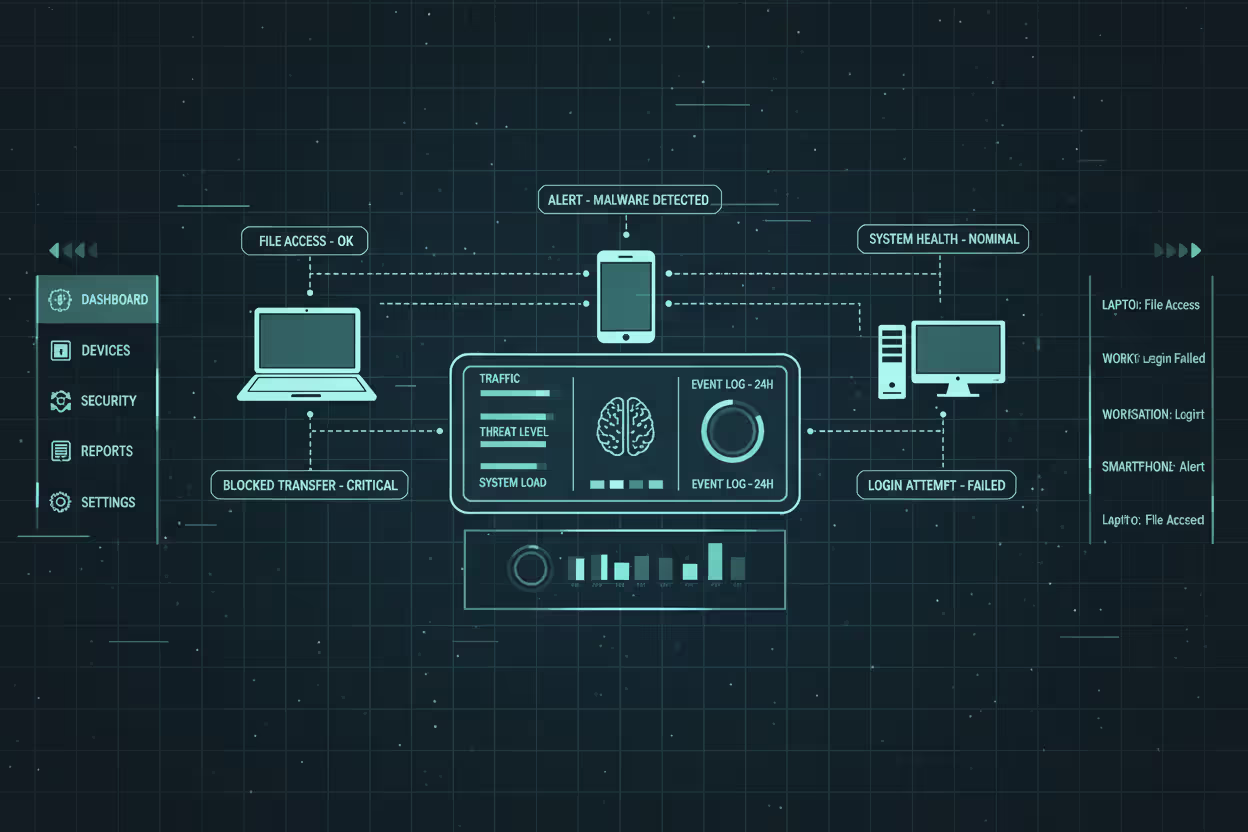
The technical foundation of how endpoint data protection works involves continuous monitoring, policy enforcement, and automated response mechanisms operating directly on each device. When an employee opens a document labeled "confidential," the protection system immediately checks multiple factors: Is this user authorized to view this classification level? Is the device compliant with security policies? Is the network connection secure enough for this data sensitivity?
Monitoring agents installed on each endpoint track file activities in real time—creation, modification, copying, printing, and transmission. These agents compare observed behaviors against predefined policies. For example, a policy might state: "Financial spreadsheets containing Social Security numbers cannot be uploaded to personal cloud storage accounts." When someone attempts this action, the agent blocks the transfer and alerts security administrators.
Author: Daniel Prescott;
Source: williamalmonte.net
Encryption serves as the fundamental technical control. Full-disk encryption protects data when devices are powered off or stolen. File-level encryption adds granular protection, allowing different sensitivity levels for different documents. When a user opens an encrypted file, the system decrypts it in memory only after verifying credentials and device compliance—the decrypted version never writes to disk in plain text.
Access controls extend beyond simple passwords. Modern endpoint data protection systems evaluate device health (Is antivirus current? Are patches installed?), location (Is this a trusted network?), and behavioral patterns (Does this 3 AM file access match normal working hours?) before granting access to sensitive information. Multi-factor authentication adds another verification layer, requiring something you know (password), something you have (smartphone), or something you are (fingerprint).
Data loss prevention mechanisms analyze content in real time. When an employee attempts to email a document, the system scans for patterns matching credit card numbers, medical record identifiers, or proprietary code. Matches trigger actions ranging from warnings to automatic blocking. Some systems apply machine learning to detect sensitive information even without obvious patterns—recognizing engineering diagrams or strategic plans through contextual analysis.
Key Components of Endpoint Data Protection
Data Encryption and Access Control
Encryption transforms readable data into scrambled ciphertext that requires a cryptographic key to decode. Organizations typically deploy three encryption types across endpoints: full-disk encryption protects everything on the storage drive, file-level encryption secures individual documents, and network encryption (VPN) protects data during transmission.
The practical challenge involves key management. If employees forget encryption passwords, data becomes permanently inaccessible. Enterprise solutions use key escrow systems where IT maintains recovery keys under strict access controls. Some implementations use hardware-based encryption through Trusted Platform Module (TPM) chips, which store keys separately from the main storage—making them nearly impossible to extract even with physical device access.
Access control systems determine who can view, edit, or share specific information. Role-based access control (RBAC) assigns permissions based on job function—accountants access financial records, developers access source code, but neither group sees the other's files. Attribute-based access control (ABAC) adds contextual factors: a doctor might access patient records from hospital networks but face restrictions when connecting from public WiFi.
Granular controls extend to specific actions. A user might view a document but cannot print, screenshot, or forward it. These restrictions follow the file even when shared—a capability called persistent protection. When someone emails a protected document, the recipient must authenticate before opening it, and the original creator can revoke access at any time.
Threat Detection and Response
Endpoint data protection systems continuously analyze device behavior for signs of compromise. Behavioral analytics establish baseline patterns—typical file access times, common applications used, normal data transfer volumes. Deviations trigger alerts: Why is this accounting workstation suddenly accessing thousands of customer records at midnight? Why is this laptop uploading gigabytes to an unfamiliar cloud service?
Machine learning models improve detection accuracy over time, learning to distinguish legitimate business activities from suspicious patterns. An employee working late on a quarterly report might access many files, but the access pattern differs from ransomware systematically opening and encrypting files. The system recognizes these nuances without requiring explicit rules for every scenario.
Automated response capabilities limit damage when threats appear. Upon detecting ransomware behavior, the system might immediately isolate the device from network shares, preventing encryption spread to file servers. It might force-close suspicious applications or revert files to pre-infection versions from shadow copies. These automated actions contain threats during the critical minutes before security staff respond.
Forensic capabilities support post-incident investigation. Detailed logs capture every file access, modification, and transmission—creating an audit trail that reveals how breaches occurred and what data was compromised. This information proves essential for regulatory compliance reporting and improving future defenses.
Data Loss Prevention (DLP)
Data loss prevention specifically addresses intentional or accidental information leakage. DLP systems classify data based on sensitivity—public, internal, confidential, restricted—then enforce handling rules appropriate to each classification. The classification might happen automatically through content inspection (documents containing "CONFIDENTIAL" headers) or manually through user-applied labels.
Content inspection examines data at rest (stored files), in motion (network transmission), and in use (open in applications). Pattern matching identifies regulated data types: credit card numbers following Luhn algorithm validation, Social Security numbers matching XXX-XX-XXXX format, or medical record numbers conforming to healthcare identifiers. Dictionary matching finds specific terms—product code names, executive names, or proprietary project titles.
Contextual analysis adds sophistication beyond simple pattern matching. A document containing the words "patient," "diagnosis," and "treatment" alongside names and dates likely represents protected health information even without explicit medical record numbers. The system flags it for special handling based on this contextual understanding.
Policy enforcement offers flexible responses to policy violations. Hard blocking prevents the action entirely—the email won't send, the file won't upload. Soft blocking allows override with business justification—the user explains why they need to email this file externally, creating an audit record. User education mode displays warnings without blocking, helping train employees on proper data handling while gathering metrics on violation frequency.

Author: Daniel Prescott;
Source: williamalmonte.net
Common Endpoint Data Protection Examples
Remote work scenarios represent the most common endpoint data protection examples in current enterprise environments. A financial analyst working from home accesses sensitive merger documents on a personal laptop. Endpoint data protection ensures the laptop meets security standards (current patches, active antivirus), encrypts the documents both at rest and during download, prevents copying to USB drives or personal cloud storage, and automatically deletes cached copies when the work session ends. If the laptop is stolen, the encrypted data remains unreadable, and remote wipe capabilities erase everything before thieves can attempt decryption.
Bring-your-own-device (BYOD) policies create unique challenges—employees want to use personal smartphones and tablets for work, but organizations must protect corporate data without invading personal privacy. Endpoint data protection solutions create secure containers on personal devices, separating work apps and data from personal content. Corporate emails, documents, and applications live in the encrypted container with enforced security policies, while personal photos, messages, and apps remain untouched. If an employee leaves the company, IT wipes only the corporate container, leaving personal data intact.
Healthcare organizations face strict HIPAA requirements protecting patient information. A physician using a tablet to review patient charts during hospital rounds relies on endpoint data protection to encrypt all stored data, require biometric authentication for access, and prevent screenshots of medical records. If the physician needs to share test results with a specialist, DLP policies ensure transmission occurs through secure, audited channels rather than unencrypted email. Automatic session timeouts lock the device after brief inactivity periods, preventing unauthorized viewing if the physician sets down the tablet during an emergency.
Financial services firms deal with multiple compliance frameworks—PCI DSS for payment card data, GLBA for consumer financial information, and SEC regulations for material non-public information. A wealth advisor's laptop accessing client portfolios uses endpoint data protection to classify documents by data type, apply appropriate encryption and access controls, monitor for insider trading indicators (unusual access to merger-related files before announcements), and maintain detailed audit logs proving compliance during regulatory examinations.
Manufacturing companies protecting intellectual property face industrial espionage risks. An engineer's workstation containing product designs uses endpoint data protection to watermark all technical drawings (enabling leak source identification), block transfers to unauthorized devices or cloud services, and alert security when someone accesses unusual volumes of proprietary files. If a competitor approaches the engineer, the protection systems make stealing designs technically difficult and forensically traceable.
Endpoint Data Protection vs. Endpoint Security
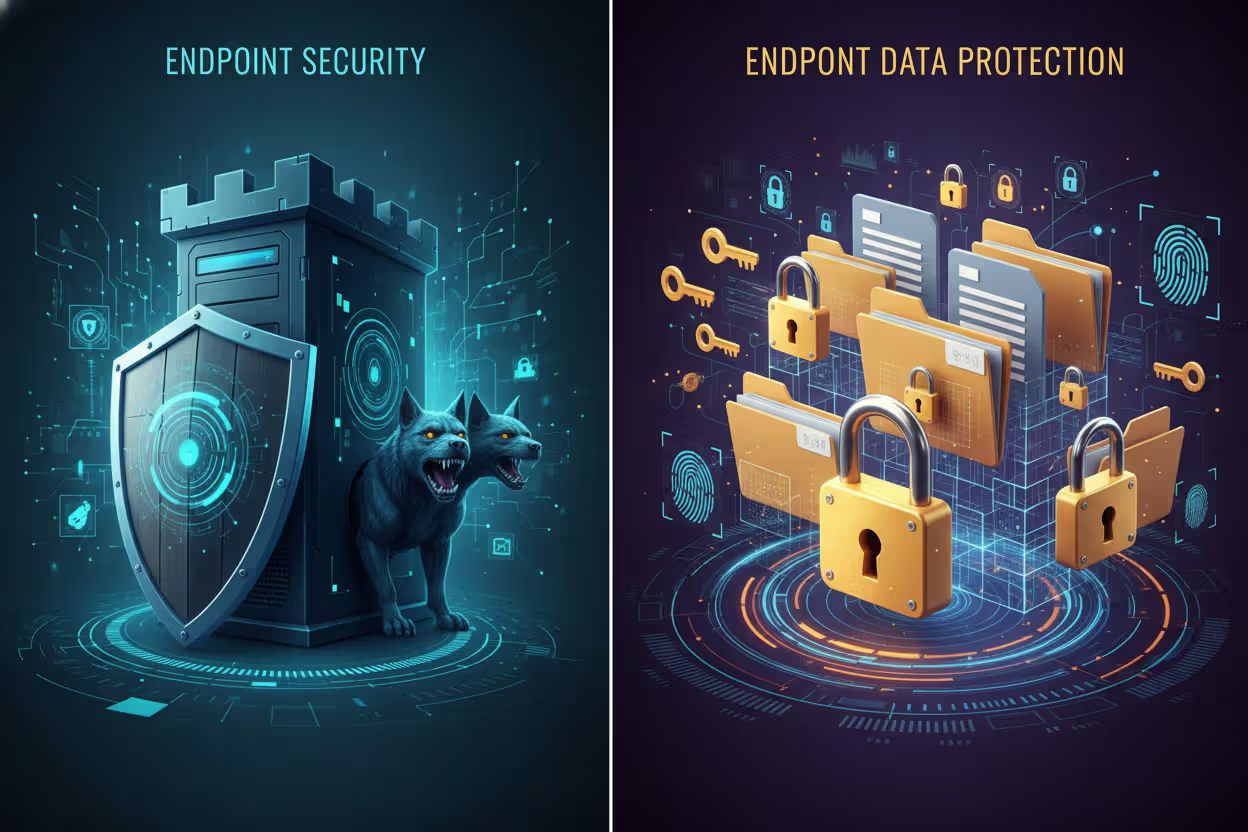
The relationship between endpoint data protection and broader endpoint security resembles the difference between a safe protecting valuables versus a comprehensive home security system. Endpoint security encompasses all measures protecting devices from threats—antivirus detecting malware, firewalls blocking network attacks, patch management fixing vulnerabilities, and device hardening reducing attack surfaces. Endpoint data protection focuses specifically on information security—ensuring sensitive data remains confidential, unaltered, and accessible only to authorized parties.
Author: Daniel Prescott;
Source: williamalmonte.net
Endpoint security asks: "Is this device safe from compromise?" Endpoint data protection asks: "Is the data on this device protected even if the device is compromised?" A device might have current antivirus and firewalls (good endpoint security) yet still leak data through employee error or social engineering (poor endpoint data protection). Conversely, perfectly encrypted and access-controlled data (strong endpoint data protection) still faces risks if malware can capture keystrokes or screenshots (weak endpoint security).
The overlap between these disciplines has grown as security vendors integrate capabilities. Modern endpoint protection platforms (EPP) combine traditional security with data protection features. However, specialized data protection tools often provide deeper capabilities—more sophisticated DLP rules, granular encryption options, and detailed data flow visibility that general security suites lack.
Organizations typically need both approaches working together. Endpoint security prevents malware from stealing data by blocking the malware itself. Endpoint data protection ensures that if malware somehow succeeds, the stolen data remains encrypted and unusable. This defense-in-depth strategy acknowledges that no single control provides perfect protection—layered defenses compensate for individual failures.
Budget-constrained organizations sometimes face choosing between investing in stronger endpoint security or better data protection. The decision depends on threat priorities: Companies facing sophisticated nation-state hackers need robust endpoint security to prevent advanced persistent threats. Companies primarily concerned with employee error or basic theft benefit more from strong data protection that limits damage from common incidents.
When Your Organization Needs Endpoint Data Protection
Several indicators suggest an organization has reached the point where endpoint data protection becomes necessary rather than optional. The most obvious sign is handling regulated data types—healthcare records, payment card information, personally identifiable information—that trigger legal requirements for protection controls. HIPAA explicitly requires encryption of electronic protected health information on mobile devices. GDPR mandates appropriate technical measures protecting personal data, with encryption serving as a primary example. PCI DSS requires encryption of cardholder data across all systems, including endpoints.
Remote workforce expansion dramatically increases endpoint risk. When employees worked exclusively in offices, network perimeter security provided some protection—firewalls, intrusion detection, and network DLP monitored data flows. Remote workers bypass these controls, accessing data from home networks, coffee shops, and airports. Without endpoint-level protection, sensitive information flows across untrusted networks and resides on devices in unsecured locations.
High-value intellectual property justifies endpoint data protection investment even without regulatory requirements. A pharmaceutical company's drug research, a manufacturer's product designs, or a retailer's pricing algorithms represent competitive advantages worth millions. The cost of implementing endpoint data protection pales compared to losses from IP theft enabling competitor advantage or hostile nation-state economic espionage.
Previous security incidents often trigger endpoint data protection adoption. After experiencing a data breach through stolen laptops or insider theft, organizations recognize their vulnerability and implement controls preventing recurrence. This reactive approach costs more than proactive protection—incident response, notification, credit monitoring, regulatory fines, and reputation damage typically exceed prevention costs by orders of magnitude.
Third-party risk introduces another driver. Organizations sharing sensitive data with contractors, partners, or vendors need assurance that these external parties protect information adequately. Requiring endpoint data protection as a contractual obligation—and verifying compliance through audits—reduces supply chain security risks.
Company size matters less than data sensitivity. Small medical practices handling patient records need endpoint data protection as much as large hospital systems. A five-person startup developing valuable technology requires protection comparable to established tech giants. The implementation scale differs, but the fundamental need remains constant when sensitive data exists on endpoints.
Organizations no longer control the physical or network perimeter, making endpoint-level data protection the last reliable control point. We're seeing attackers specifically target endpoints as the weakest link in otherwise strong security architectures. Encryption and data loss prevention aren't optional extras anymore—they're foundational controls that should be deployed universally before allowing any device to access sensitive information
— Sarah Chen
Frequently Asked Questions About Endpoint Data Protection
Endpoint data protection has evolved from a specialized compliance requirement to a fundamental security control for any organization handling sensitive information. The convergence of remote work, sophisticated threats, and stringent regulations makes endpoint-level controls essential rather than optional. Devices will continue leaving secure networks, employees will keep making mistakes, and attackers will persist in targeting valuable data—endpoint data protection provides the defensive layer that limits damage when other controls fail.
Successful implementation requires balancing security with usability. Overly restrictive policies frustrate employees and encourage workarounds that undermine protection. The goal is making secure data handling the path of least resistance—automatic encryption, transparent authentication, and intelligent policies that permit legitimate work while blocking genuine risks. Organizations that achieve this balance gain security without sacrificing productivity.
Starting with a clear inventory of sensitive data and the endpoints accessing it provides the foundation for effective protection. Not all data requires maximum security—public marketing materials need less protection than customer financial records. Applying appropriate controls based on actual risk optimizes both security and resource allocation. Small pilot programs testing policies with a limited user group help identify issues before enterprise-wide deployment.
The endpoint data protection landscape continues evolving as new technologies emerge and threats adapt. Zero-trust architectures that verify every access request regardless of source, artificial intelligence that detects subtle data exfiltration patterns, and quantum-resistant encryption preparing for future computing capabilities all represent directions the field is moving. Organizations investing in flexible, extensible platforms position themselves to adopt these advances without replacing entire infrastructures.
Ultimately, endpoint data protection succeeds when it becomes invisible to users doing legitimate work while remaining impenetrable to unauthorized access. This balance requires ongoing refinement as business needs change, threats evolve, and technologies advance. Organizations treating endpoint data protection as a continuous process rather than a one-time project build resilient defenses that adapt to whatever challenges emerge in an increasingly dangerous digital landscape.
Related Stories

Read more

Read more



The content on this website is provided for general informational and educational purposes only. It is intended to explain concepts related to endpoint security, cybersecurity practices, threat prevention, and security technologies.
All information on this website, including articles, guides, and examples, is presented for general educational purposes. Cybersecurity requirements and implementations may vary depending on organizational needs, infrastructure, regulatory requirements, and threat environments.
This website does not provide professional cybersecurity, legal, or compliance advice, and the information presented should not be used as a substitute for consultation with qualified cybersecurity professionals.
The website and its authors are not responsible for any errors or omissions, or for any outcomes resulting from decisions made based on the information provided on this website.